
Property Owners: 2026 Non Resident Tax Spain Steps and 3% Refunds
If you own Spanish property, rent it out, sold it, or collected any Spanish-source income while living abroad, you almost certainly owe non-resident tax filings in Spain through Modelo 210. Rates run at a general rate for most non-residents and at a reduced rate for many EU/EEA residents, and the clock starts differently depending on whether the income is rental, imputed, or a capital gain. Your first move: confirm your residency status and gather your NIE/NIF and cadastral reference before anything else.
TL;DR:
- Non-resident property owners in Spain must file Modelo 210 if they own, rent, sell, or receive income from Spanish sources, regardless of where they live.
- EU and EEA residents benefit from 19% rates on rental income and deductions, while non-EU owners pay 24% on gross rental or imputed income without deductions.
- Property sales are taxed at 19% capital gains, with buyers withholding 3% using Modelo 211, which sellers must reconcile through the same form.
- Residency status depends on spending fewer than 183 days in Spain and having a center of economic interests outside the country, affecting filing obligations.
- Appointing a Spanish fiscal representative is mandatory for most non-EU owners and highly recommended for EU residents to handle communications and compliance.
Table of Contents
- Non-Resident Tax Spain at a Glance
- Who Actually Has to File Modelo 210?
- How Rental, Vacant, and Sold Property Get Taxed
- IRNR Rates and What Tax Treaties Change
- Which Form, and When It’s Due
- Filing Modelo 210 Step by Step
- Do You Need a Tax Representative?
- Where Non-Resident Filers Go Wrong
- Can EU Residents Appoint a Tax Representative Too?
- Getting a NIE or NIF as a Non-Resident
- How IRNR Treats Different Kinds of Investment Income
- Author’s Quick Checklist and Recommended Next Steps
- How Law Cappital Handles IRNR Filings
- Where to Verify the Details
- Sources
Non-Resident Tax Spain at a Glance
Spain’s non-resident income tax, known as IRNR (Impuesto sobre la Renta de No Residentes), only reaches income sourced in Spain. That is the core distinction from IRPF, the tax residents pay on worldwide income. Own a Madrid apartment while living in Frankfurt or Chicago? Spain taxes the rent or the imputed value of that apartment, not your salary back home.
Four forms cover almost every non-resident scenario:
- Modelo 210: the main non-resident declaration, used for rental income, imputed income on vacant property, and capital gains.
- Modelo 211: filed by the buyer of a property to withhold 3% of the price when the seller is a non-resident.
- Modelo 216: used by payers (employers, banks) to report withholdings on non-resident income at source.
- Modelo 213: a special annual levy on real estate owned through certain non-resident entities.
The Tax Agency’s non-resident guidance lays out the full mechanics for each. Imputed income on vacant homes is calculated as a percentage of cadastral value, and getting that number wrong is one of the most common triggers for a Tax Agency inquiry.
Who Actually Has to File Modelo 210?
Spain treats you as a non-resident for tax purposes if you spend fewer than 183 days a year in the country and your center of economic interests sits elsewhere, per the residency tests the Tax Agency applies. Once that status is settled, the filing question comes down to what kind of Spanish income you have.
You need to file Modelo 210 if any of these apply:
- You own a second home in Spain that sits empty part or all of the year (imputed income).
- You rent out a Spanish property to tenants (rental income).
- You sold Spanish real estate during the tax year (capital gains).
- You receive Spanish-source dividends, interest, or investment income not fully settled through automatic withholding.
Withholding at source sometimes closes the loop, particularly for certain dividends and interest paid through a Spanish bank. It does not close the loop for rental income or capital gains, where you must reconcile the actual liability yourself. A double taxation agreement between Spain and your home country can reduce or eliminate the burden, but you need a certificate of tax residence from your home tax authority to claim it. Without that certificate, Spain applies its domestic rate by default.
How Rental, Vacant, and Sold Property Get Taxed
Three property situations cover most non-resident filers, and each has its own math.
- Rented property. EU/EEA residents can deduct actual expenses (mortgage interest, community fees, repairs, agency commissions) before applying the 19% rate to net rental income. Non-EU residents don’t get that deduction. They pay 24% on the gross rent received, with no expense offset.
- Vacant property. Even an empty holiday home generates a tax bill. The Tax Agency calculates imputed income at 1.1% of cadastral value if that value was revised after 1994, or 2% if it wasn’t. That figure gets taxed at the same 24%/19% rates, filed annually.
- Sold property. Capital gains are generally taxed at 19% regardless of your EU/EEA status. The buyer must withhold a percentage of the full sale price and submit it via Modelo 211 as an advance payment on your behalf.
Two quick examples show how this plays out. A cadastral value of $200,000 revised since 1994 produces imputed income of $2,200 (1.1%), taxed at 19% for an EU resident: a bill of roughly $418 a year, even with zero rental activity.
On a sale, say a $350,000 property with a $50,000 gain. The seller files Modelo 210 to reconcile the two figures and claims a refund for the $1,000 overpaid. Skip that filing and the money simply stays with the Tax Agency.
IRNR Rates and What Tax Treaties Change
The headline numbers are straightforward, but the exceptions matter more than the rule. Spain applies 24% as the general non-resident rate, dropping to 19% for tax residents of the EU, Iceland, and Norway where effective exchange of tax information exists between Spain and that jurisdiction, according to both the Tax Agency and PwC’s Spain tax summary.
Pensions follow a different path entirely, taxed on a progressive scale rather than the flat IRNR rates, which can work in your favor or against you depending on the total amount received.
To claim any treaty benefit, you generally need:
- A certificate of tax residence issued by your home country’s tax authority, valid for the relevant year.
- The correct treaty article identified for your income type (pensions, dividends, capital gains, and rental income are often treated differently within the same treaty).
- Timely submission, since treaty relief usually cannot be applied retroactively once a filing deadline has passed.
EU/EEA residents also have access to an optional scheme that mirrors IRPF treatment more closely and can lower the effective tax bill, though the rules around this election are dense enough that most people benefit from professional review before choosing it.
Which Form, and When It’s Due
Matching the right form to the right income type avoids half the headaches non-residents run into.
- Modelo 210 covers rental income, imputed income, and capital gains, the three most common non-resident filings.
- Modelo 211 is filed by the property buyer, not the seller, to report the 3% withholding within one month of the sale.
- Modelo 216 is used by Spanish payers (banks, employers) reporting withholdings on non-resident income at source, generally quarterly.
- Modelo 213 applies only to the special annual levy on real estate held through certain non-resident corporate structures.
Deadlines vary by income type. Imputed income is filed annually, generally by the end of the following calendar year. Rental income can be filed quarterly or, in some cases, consolidated annually. Capital gains from a property sale must be filed within four months of the transfer date. Procedural updates under Order HAC/623/2026 have refined some of the electronic submission requirements and filing windows for Modelo 210, so it’s worth confirming the current version before you file. Payment can be made electronically with a digital certificate or Cl@ve system, or through a bank pre-declaration for those without electronic credentials. Keep every filing receipt and supporting document for at least four years.
Filing Modelo 210 Step by Step
Getting the paperwork right the first time saves months of correspondence with the Tax Agency later.
- Step 1: Confirm your non-resident status and identify every category of Spanish income you need to declare that tax year.
- Step 2: Collect your NIE or NIF, the property’s cadastral reference, sale or rental contracts, and any withholding certificates from buyers or tenants.
- Step 3: Calculate the taxable base. EU/EEA residents subtract eligible expenses from rental income before applying the rate; imputed income uses the 1.1% or 2% cadastral formula. Non-EU residents apply the rate to gross income directly.
- Step 4: Submit the form online or through a pre-declaration at a bank, pay any amount due, and keep the filing confirmation. If withholding exceeded your actual liability, attach proof of the withheld amount to request a refund.
Pro Tip: Run your numbers through the Tax Agency’s own IRNR calculator before submitting. It won’t file the form for you, but it catches basic arithmetic errors before they become a written inquiry.
Do You Need a Tax Representative?
Spain generally requires non-residents from outside the EU/EEA to appoint a fiscal representative, a Spain-based individual or firm authorized to receive communications from the Tax Agency and act on the filer’s behalf. This isn’t optional paperwork. It’s how the Tax Agency ensures someone reachable inside its jurisdiction can respond to notices.
- Representatives must be registered with the tax office and formally accept the role in writing.
- Electronic notifications carry strict timing: once a digital demand is issued, you typically have 10 calendar days to respond or pay before penalties escalate.
- Ongoing obligations include keeping cadastral records current, retaining rental or sale documentation, and filing on the correct schedule for each income type.
Missing an electronic notification because nobody was watching the inbox is one of the most avoidable, and most common, compliance failures among non-resident owners.
Where Non-Resident Filers Go Wrong
The mistakes that trigger Tax Agency attention tend to repeat across cases. Failing to declare imputed income on a vacant second home is the most frequent one. Owners assume that if the property isn’t generating rent, there’s nothing to report. There is. Misclassifying residency status is another, especially for people who split time between two countries without formally establishing where their center of economic interests sits. And after a property sale, plenty of sellers never file Modelo 210 to reconcile the 3% withholding, leaving money with the Tax Agency they were entitled to reclaim.
The Tax Agency has leaned harder into digital demands and cross-referenced data sharing in recent years, comparing declared property values against cadastral records automatically. A mismatch that once went unnoticed for years now quickly surfaces.
Mitigating that risk comes down to a short list: file within the correct windows for each income type, appoint a representative when required, retain cadastral certificates and municipal records as backup evidence, and claim treaty relief with proper documentation rather than assuming it applies automatically. Some specialized law firms have developed non-resident practices focused on addressing these recurring failure points, working with foreign owners who discover mid-audit that a filing they didn’t know about was due years earlier.
If you inherited Spanish property from a relative, the imputed income clock starts the moment the title transfers into your name, not when you first visit the property.
Can EU Residents Appoint a Tax Representative Too?
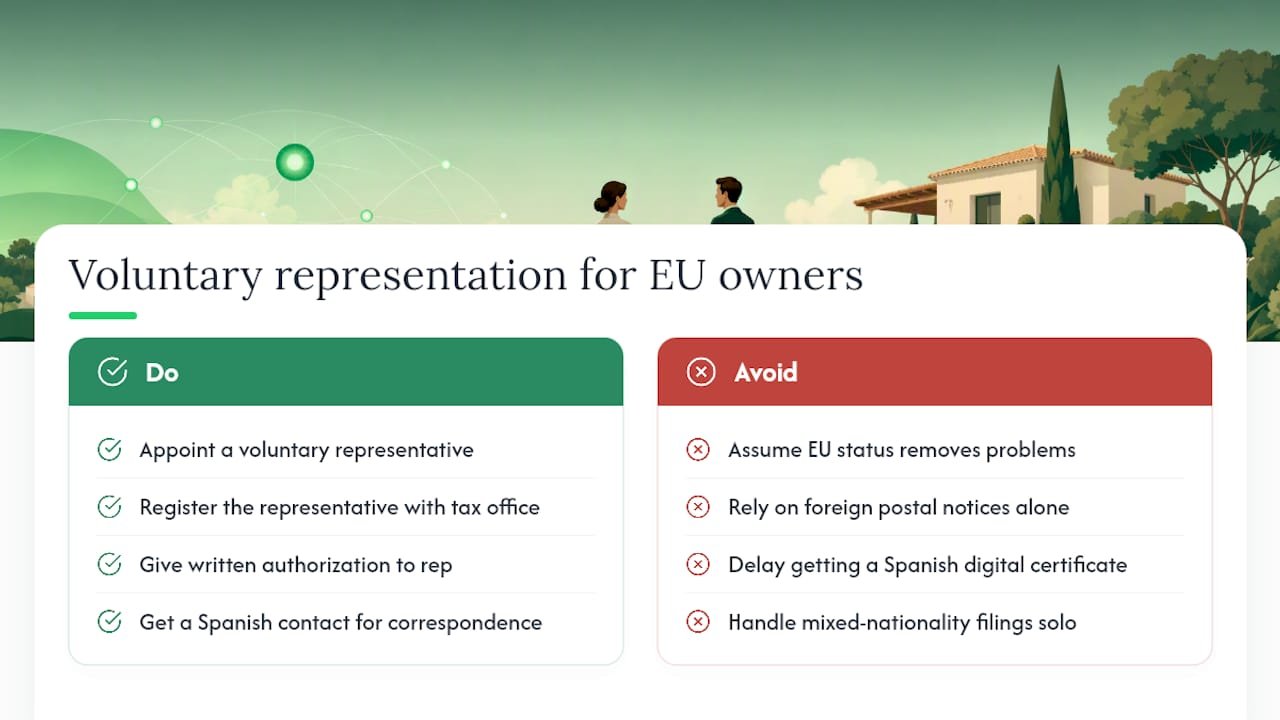
Mandatory representation rules apply mainly to non-EU/EEA residents, but EU residents are not barred from appointing one. Plenty do, and often for good reason.
An EU resident isn’t legally required to have a Spain-based representative in most cases, since the Tax Agency assumes easier cross-border communication and enforcement within the EU/EEA framework. That assumption doesn’t always match reality. Postal notices sent to a foreign address get delayed. Digital notification systems require a Spanish digital certificate that many EU owners never bother obtaining until they actually need it, at which point the 10-day response clock is already running.
Appointing a voluntary representative solves a few practical problems at once. It gives you a Spanish point of contact who can receive and respond to Tax Agency correspondence in real time, rather than discovering a demand six weeks after it landed in a mailbox at your primary residence. It also helps if you own property jointly with a non-EU spouse or partner, since mixed-nationality ownership can create representation requirements for one party but not the other, and coordinating filings separately gets messy fast.
The conditions for a voluntary appointment mirror the mandatory ones: written authorization, registration with the relevant tax office, and a representative willing to take on the administrative responsibility. Cost isn’t fixed by law, so it varies by provider and scope of work. For EU owners with straightforward single-property situations, representation is a convenience. For those with multiple properties, rental income, or plans to sell, it starts looking more like a necessity.
Getting a NIE or NIF as a Non-Resident
You cannot file Modelo 210, buy property, or open a Spanish bank account without a NIE (Número de Identidad de Extranjero), the foreigner identification number that functions as your tax ID in Spain. Companies and certain other entities use a NIF instead, but for individual non-resident owners, the NIE is what you need.
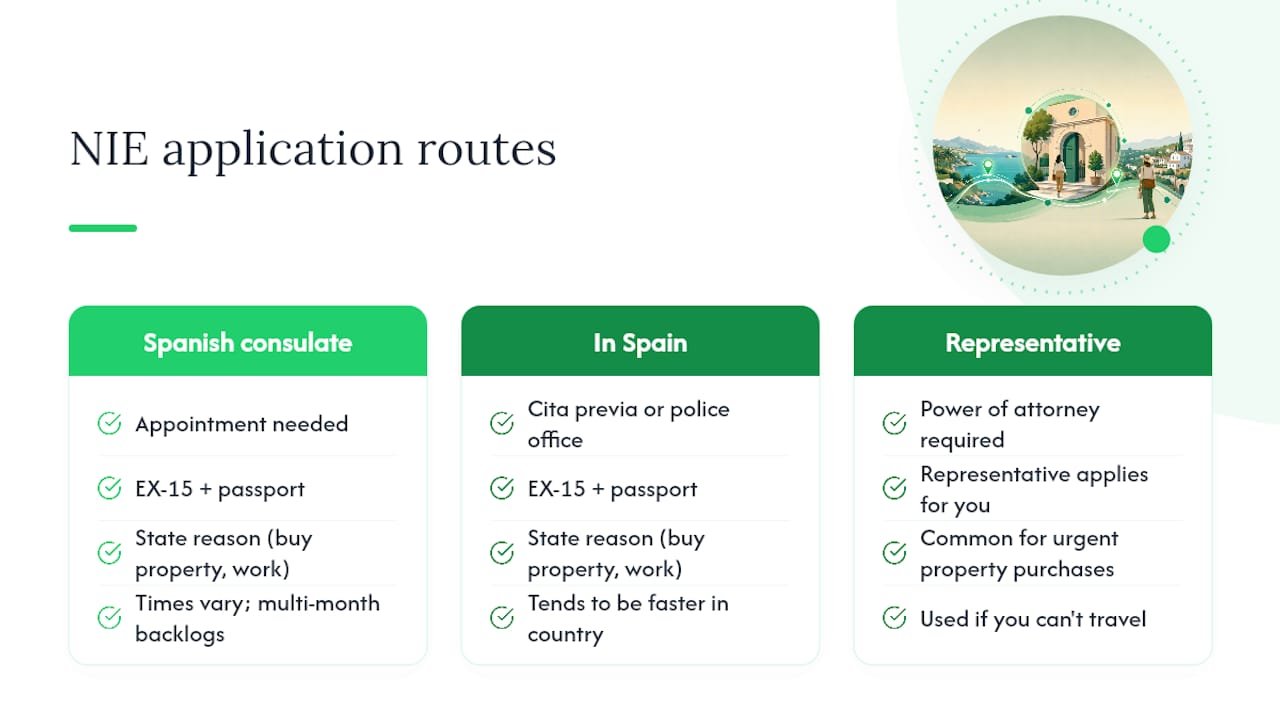
There are two main routes to get one. The first is applying at a Spanish consulate in your home country, which typically requires an appointment, a completed EX-15 form, your passport, and a stated reason for needing the number (buying property, working, or another qualifying purpose). Processing times vary significantly by consulate, and some have multi-month appointment backlogs.
The second route is applying in person in Spain, at a designated police station (Oficina de Extranjeros) or, in some provinces, through a “cita previa” appointment system that books out weeks in advance. This route tends to be faster once you’re physically in the country, since consular routes depend heavily on staffing at your specific location.
A third practical option many non-residents use: authorizing a representative with power of attorney to apply on your behalf. This is particularly common for people who need the number urgently to close a property purchase but can’t travel to Spain or wait out a consular queue.
Whichever route you take, the NIE doesn’t expire once issued, though the physical card proving it may need renewal if you become a resident later. Keep the original document. You’ll need to reference it on every Modelo 210 you ever file.
How IRNR Treats Different Kinds of Investment Income
Not all Spanish-source income gets taxed the same way under IRNR, and conflating categories is a common filing error.
Spanish banks and financial institutions typically withhold tax automatically at source on dividends and interest paid to non-residents, often satisfying the full obligation without requiring a separate Modelo 210 filing. Capital gains from selling Spanish shares or funds, by contrast, usually do require a filing to establish the actual gain, since no automatic withholding captures that calculation precisely.
Business income tells a different story. If you run a business through a permanent establishment in Spain (a branch, office, or fixed place of business), the PwC comparison of IRPF and IRNR treatment notes that income gets taxed more like resident business income, following corporate-style rules on allowable deductions rather than the simpler gross or net calculations that apply to passive property and investment income.
The practical takeaway: don’t assume one filing covers everything. A non-resident with a rental property, a Spanish brokerage account, and freelance consulting income sourced from Spain may need to track three separate calculation methods within the same tax year.
Author’s Quick Checklist and Recommended Next Steps
If you take one thing from this guide, make it this: confirm your residency status first, because everything else, rates, deductions, and which form applies, flows from that answer. Three moves matter most right now. Confirm whether you meet the 183-day non-resident threshold. Gather your NIE/NIF, cadastral reference, and any withholding certificates. Then schedule a consultation before a deadline forces the decision for you. Acting early, before a Tax Agency notice arrives, almost always costs less than reacting to one, both in penalties and in peace of mind.
— Jorge
How Law Cappital Handles IRNR Filings
Law Cappital’s tax services handle the full range of non-resident obligations: annual imputed income filings, rental income declarations, capital gains reconciliation and refund claims, fiscal representation for non-EU owners, and Beckham Law applications for those transitioning into Spanish residency under favorable terms.

An initial consultation is free and focuses on identifying exactly which forms apply to your situation and what documentation you’ll need, whether that’s a cadastral certificate, a certificate of tax residence, or proof of withholding from a buyer. Send over your property details and residency history, and the firm maps out the filing calendar specific to your case before any commitment is made. If you’re a U.S. citizen navigating both IRNR and IRS obligations simultaneously, the dedicated cross-border guidance addresses that overlap directly. Book a consultation through Law Cappital to get a clear answer on what you owe and when it’s due.
Where to Verify the Details
Cross-check the specifics in this guide against primary sources before filing, since rates and procedural details shift year to year.
- The Tax Agency’s non-resident portal covers filing procedures, model forms, and residency criteria in full.
- Procedural updates under Order HAC/623/2026 are referenced in the Tax Agency’s Modelo 210 guidance.
- For plain-language breakdowns of rates and deadlines, Wise’s IRNR guide and IR Global’s 2026 overview offer useful summaries alongside PwC’s tax comparison.
This article is general information, not a substitute for advice from a qualified financial advisor. Consult a qualified financial professional about your own circumstances before acting on anything here.
Sources
- Tax Agency: Non-residents
- Non-Resident Income Tax (IRNR) in Spain: Definition, Rates, Forms and Filing Obligations in 2026 – IR Global
- Spain – Individual – Taxes on personal income (PwC)
- Agencia Tributaria IRNR Informer / calculation tools
Recommended
