
Consulate Ready Family Reunification for Non EU Residents in Spain
Yes, you can bring your spouse, children, or dependent parents to Spain through family reunification, but the order matters more than anything else in the process. The sponsor already living in Spain must first win an authorization from the Oficina de Extranjería, and only after that approval lands can the relative walk into a consulate abroad to apply for the actual visa. Skip that sequence and the file gets rejected, no matter how strong the rest of your paperwork is. Temporary protection holders and parents follow modified versions of this same two-step logic.
TL;DR:
- The sponsor must first obtain authorization in Spain before the relative can apply for a visa at the consulate; skipping this step results in rejection.
- Spanish law limits family reunification to specific relatives, with spouses needing at least one year of residence and two renewals, while parents face stricter long-term residence requirements.
- All foreign documents must be legalized and translated into Spanish, with the housing adequacy report often being the most delayed and critical document for approval.
- The process involves three phases: authorization in Spain, consular visa application within two months, and entry plus TIE registration after arrival in Spain.
- Legal assistance is recommended for complex cases such as dependent parents, disputed documents, or prior denials to improve approval chances and navigate procedural nuances.
Table of Contents
- Who Qualifies for Family Reunification in Spain?
- What Documents Do You Need for Family Reunification?
- How Does the Family Reunification Process Work Step by Step?
- What Special Rules Apply to Temporary Protection Holders and Parents?
- How Long Does Family Reunification Take, and What If It’s Denied?
- What’s the Fastest Way to Avoid a Family Reunification Denial?
- Why Specialist Guidance Changes the Odds on Harder Cases
- How Law Cappital Can Help With Your Family Reunification Case
- Where to Verify Official Family Reunification Rules
- Sources
Who Qualifies for Family Reunification in Spain?
Spanish law recognizes a fairly narrow circle of relatives for reagrupación familiar, and the residency period the sponsor needs to have run varies depending on who they’re bringing over.
Eligible family members generally include:
- A spouse or registered/unregistered partner, provided the couple isn’t legally separated and can document the relationship with a marriage certificate or proof of a stable partnership (utility bills, joint leases, cohabitation certificates from the town hall).
- Children under 18, or adult children who are legally dependent due to disability.
- Dependent parents of the sponsor or the sponsor’s spouse, when the sponsor can show sustained financial support.
- In some cases, a legal guardian relationship substitutes for a biological one, provided it’s documented through foreign court or administrative records.
The residency requirement is where most people get tripped up. Sponsors bringing a spouse or children generally need to have held their residence permit for at least one year and to have already renewed it for a second year, according to the EU Immigration Portal’s guidance on family members in Spain. Parents face a steeper bar. Most cases require the sponsor to hold long-term (larga duración) residence status, which generally implies an extended period of continuous legal residence in Spain rather than the shorter window that applies to spouses and children.
There’s also a completely separate track for EU, EEA, and Swiss citizens’ family members: the régimen comunitario. If your sponsor holds EU or EEA nationality, or Swiss nationality, the reunification rules are lighter, the residency card process moves faster, and the income thresholds that apply to the general regime don’t apply here. Anyone in that situation should look at the EU citizen residence card process instead of the general family reunification track described in this article, since applying under the wrong regime wastes months.
What Documents Do You Need for Family Reunification?
Every document that didn’t originate in Spain needs to clear two hurdles before a consulate will look at it: legalization (apostille, in most cases) and an official translation into Spanish. Consular guidance from Spain’s own foreign ministry is blunt about this, warning applicants that foreign civil status documents must be legalized and translated before they’ll be accepted, no exceptions for documents that “look official enough.”
Here’s the practical breakdown of what each side of the application needs to assemble.
1. Sponsor’s documents (filed in Spain):
- Valid TIE (Tarjeta de Identidad de Extranjero) showing current legal residence status
- Proof of residence renewal history where applicable
- Certificado de empadronamiento (municipal registration certificate)
- Proof of sufficient income (payslips, tax returns, employment contract, or business records)
- Proof of adequate housing: a lease agreement or property deed, plus the housing adequacy report
2. Applicant’s documents (prepared for the consular stage):
- Valid passport meeting minimum validity requirements
- Criminal background certificate from the country of residence, apostilled
- Medical certificate confirming the absence of diseases with serious public health implications
- Proof of the family relationship (marriage certificate, birth certificate, partnership registration), apostilled and translated
The housing adequacy report, known as the informe de adecuación de vivienda, trips up more applicants than anything else on this list. It’s issued locally, either by the ayuntamiento or by the relevant comunidad autónoma, and it confirms the sponsor’s home has enough space and habitable conditions for the incoming family member. Requesting it typically means submitting floor plans, occupancy details, proof of ownership or a rental contract, and recent utility bills, and processing times swing wildly depending on which town hall you’re dealing with.
Parents face a heavier evidentiary burden than spouses or children. Consulates generally want documented proof of regular financial support extending back at least a year, not a lump sum sent the month before filing. A consolidated paper trail of bank transfers, remittance receipts, and invoices showing consistent payments carries far more weight than a single large deposit.
Pro Tip: Start the housing adequacy report the same week you decide to apply for family reunification. It’s the one document entirely outside your control timeline-wise, and a slow ayuntamiento can add two or three months to your case before the file even reaches immigration authorities.
How Does the Family Reunification Process Work Step by Step?
The procedure runs in three distinct phases, and jumping ahead in the sequence is the single most common reason applications collapse, according to immigration practitioners who track these cases closely, as noted by ThinkSpain’s guidance on family reunification visas.
-
Authorization in Spain. The sponsor files the initial family reunification authorization request at the Oficina de Extranjería in their province. This step happens entirely inside Spain, without the relative present, and the office reviews the sponsor’s documentation before issuing (or denying) approval.
-
Consular visa application. Once the authorization is granted, the relative has exactly two months from the notification date to apply for the national visa at the Spanish consulate covering their place of residence, a deadline confirmed directly by Spain’s consular guidance on the general family reunification scheme. This means booking a consular appointment, submitting biometrics in person, and presenting the full apostilled document set. Passport rules matter here too: several consulates note that a passport issued many years ago may be rejected outright, and minimum validity is commonly set at several months beyond the intended travel date.
-
Entry and TIE registration. Once the visa is stamped and the relative enters Spain, they generally have one month to apply for the physical TIE card at the corresponding police station or immigration office, and to complete empadronamiento at the local town hall. That TIE card is what actually authorizes them to work, access healthcare, and open bank accounts as residents rather than visa holders. Anyone unfamiliar with this last stretch should read through the step-by-step TIE application process before their relative lands, because appointment slots in major cities book out weeks in advance.
Consular appointment systems vary by country. Some posts run online booking portals with real-time slot availability, others require phone requests or email queues. If a consulate requests additional documents mid-process, don’t ignore the request or assume it will resolve itself. Respond within the window given, and keep dated copies of every submission for your own records.
What Special Rules Apply to Temporary Protection Holders and Parents?
Not every applicant follows the standard track, and two categories in particular carry meaningfully different rules.
- Temporary protection beneficiaries. People granted temporary protection in Spain, Ukrainian nationals being the largest current group, can request family reunification for a spouse, children under 18, and dependent parents. According to UNHCR’s guidance on family reunification in Spain, these requests go through the Oficina de Asilo y Refugio (OAR) rather than the standard extranjería channel, and the documentary standard is adapted to account for the reality that many beneficiaries fled without access to apostilled paperwork.
- Parents. Beyond the long-term residency requirement for the sponsor, parents need to prove genuine financial dependency, not just a family connection. Consulates commonly expect a documented history of remittances sent over the preceding year, at minimum, rather than a single recent transfer. Legal practitioners consistently flag that dependency gets assessed strictly, and sustained, dated support matters far more than the total amount sent.
- Adult disabled children or humanitarian grounds. When the relative is an adult child, authorities want medical documentation establishing the disability and its practical effect on the person’s ability to live independently, alongside proof the sponsor has been the one providing care or support.
- EU, EEA, and Swiss family members. If the sponsor holds nationality from one of these countries, forget the general regime described above entirely. The régimen comunitario applies instead, with faster processing and different eligibility rules.
How Long Does Family Reunification Take, and What If It’s Denied?
The consular stage carries a hard statutory clock: the relative must submit their visa application within two months of the authorization notification, and consulates generally aim to decide within a similar window. The authorization phase in Spain doesn’t move as predictably. Provincial extranjería offices vary widely in backlog, and a file that should take weeks can stretch into months if the office requests clarifications.
If your application gets denied, here’s what actually happens next:
- Read the denial notice carefully. It has to state the specific grounds, whether that’s insufficient income, an inadequate housing report, or missing documentation.
- You can file a recurso de reposición (an administrative appeal) directly with the office that issued the denial, generally within one month of notification.
- If that appeal fails, judicial review through the contentious-administrative courts remains available, though it runs on a longer timeline and typically benefits from legal representation.
- If the denial cites a fixable gap, like a missing translation or an outdated housing report, it’s often faster to correct the file and refile than to appeal.
Pro Tip: Don’t wait for a denial to check your consulate’s specific document list. Every consular jurisdiction publishes its own supplementary form requirements. What satisfied one Spanish consulate can bounce back at another purely on formatting grounds.
What’s the Fastest Way to Avoid a Family Reunification Denial?
Most refusals trace back to a handful of preventable errors, and catching them before submission saves months.
Run through this before you file anything:
- Confirm every foreign document has been apostilled and translated into Spanish, not just the ones that seem obviously official.
- Request the housing adequacy report the moment you decide to apply, since local processing delays are the most common bottleneck.
- For parent cases, assemble at least a year of dated remittance records rather than relying on recent transfers.
- Double check empadronamiento, income proof, and insurance documentation are current, not several months stale.
- Verify the applicant’s passport meets validity and age requirements before booking any consular appointment.
The mistakes that sink applications most often:
- Applying for the consular visa before the Spain-side authorization is granted.
- Submitting a housing report that doesn’t match the actual number of household occupants.
- Weak or inconsistent dependency evidence for parent cases.
- Missing a consulate’s own specific form, on top of the general national requirements.
If you catch an omission after filing, don’t sit on it. Submit a written clarification to the office handling your case immediately, referencing your file number, rather than waiting for a formal request that may take weeks to arrive.
Why Specialist Guidance Changes the Odds on Harder Cases
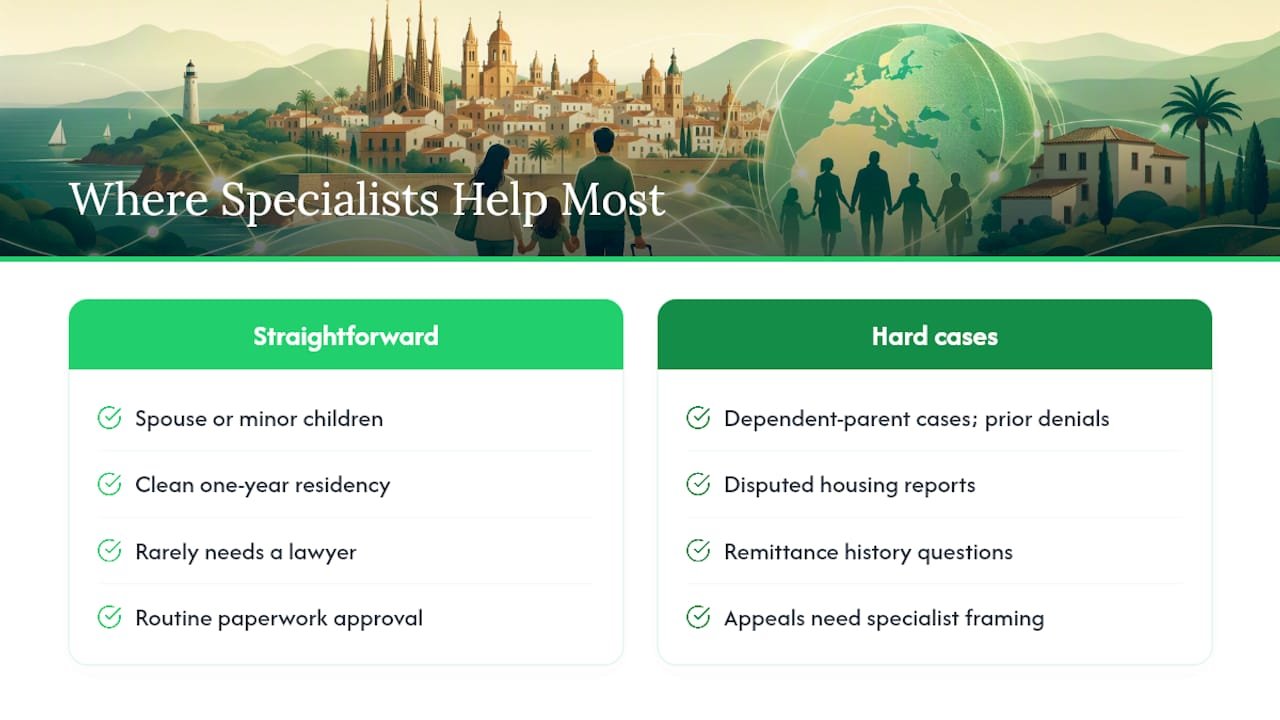
The straightforward cases, a spouse or minor children joining a sponsor with a clean one-year residency history, rarely need a lawyer’s help. Where things get genuinely difficult is dependent-parent cases, disputed housing reports, and any file that’s already been denied once. That’s where the evidentiary judgment calls start to matter more than the paperwork itself: how much remittance history is enough, what a housing report needs to say to survive review, how an appeal should be framed.
The managing partner at a Madrid-based law firm has built the firm’s immigration practice around exactly these gray areas, working alongside the tax and corporate teams so that a client’s residency status, tax position, and family situation get evaluated together rather than in isolation…
— Jorge
How Law Cappital Can Help With Your Family Reunification Case
If you’ve read this far and you’re staring down a dependent-parent case, a prior denial, or just a stack of documents you’re not confident are consulate-ready, that’s precisely where a specialist earns their fee. Specialist legal services can handle the parts of family reunification that trip up self-filed applications most: reviewing your evidence before submission, filing the authorization request with the Oficina de Extranjería, coordinating the consular stage with your relative abroad, and building appeals when a case has already been denied.
An initial consultation is free, and it’s bilingual, so you’re not translating your own legal situation on the fly. Bring your residency card, your income documentation, and whatever paperwork you’ve gathered so far, and the firm can tell you within that first conversation whether your file is strong, what’s missing, and how long a realistic timeline looks for your specific situation. Start by reviewing the firm’s immigration services page and requesting a consultation directly from there.
Where to Verify Official Family Reunification Rules
Procedural details shift by consulate and by case, so cross-check anything critical against primary sources. The EU Immigration Portal covers eligibility and residency thresholds at a policy level. Spain’s own consular guidance on the general family reunification visa scheme lays out document and timing requirements consulate by consulate. Temporary protection beneficiaries should start with UNHCR’s family reunification guidance for Spain.
This article is general information, not a substitute for advice from a qualified lawyer. Consult a qualified legal professional about your own circumstances before acting on anything here.
Sources
- Family member in Spain – Migration and Home Affairs
- UNHCR: Information on family reunification (Spain)
Recommended
