
5 Steps for Non EU Firms to Appoint a Fiscal Representative in Spain

Most non-EU companies selling into Spain, holding Spanish stock, or generating Spanish-source income must appoint a fiscal representative, and some non-resident individuals do too. The representative registers you with the Agencia Estatal de Administración Tributaria (AEAT), files your VAT and non-resident income tax returns, and becomes jointly and severally liable for what you owe. The legal basis sits in Article 164 of Ley 37/1992 for VAT and Article 10 of the LIRNR for non-resident income tax. A handful of countries with mutual-assistance agreements with Spain get exemptions, but the default assumption for a non-EU business is: you need one.
TL;DR:
- Most non-EU companies importing goods, holding inventory, or selling directly to Spanish consumers must appoint a fiscal representative for VAT and tax filings.
- The representative is jointly liable for all unpaid taxes and must handle AEAT filings, including VAT returns, IRNR, and withholding tax, with liability extending up to four years.
- Appointing a representative requires notarized documents, AEAT Form 036 registration, a digital certificate, and coordination with Spanish payers, which can take weeks.
- The cost of fiscal representation includes setup fees, ongoing compliance fees, and potential guarantees due to the joint liability risk borne by the representative.
- Proper termination involves filing a formal cessation, settling all liabilities, and ensuring AEAT official confirmation; liability for past filings remains up to four years.
Table of Contents
- What Is a Fiscal Representative in Spain?
- Who Actually Needs to Appoint One?
- What Liability Does the Representative Actually Carry?
- How to Appoint a Fiscal Representative in Spain
- Which Returns Does the Representative File?
- What Does Fiscal Representation Cost?
- How Do You End Fiscal Representation?
- How Law Cappital Handles Your Fiscal Representation
- Why Compliance-First Beats Cheapest-Option Thinking
- Get Your Spanish Fiscal Representation Set Up Correctly
- Sources
What Is a Fiscal Representative in Spain?
A fiscal representative is a Spain-based person or firm that AEAT holds jointly liable for your tax debts while acting as your registered point of contact for filings and correspondence. The role traces back to two statutes: Article 164 of Ley 37/1992 governs VAT representation, and Article 10 of the LIRNR (Royal Legislative Decree 5/2004) covers non-resident income tax. Neither statute treats this as a paperwork formality. The representative’s own assets are on the line if your Spanish tax debts go unpaid.
That is the sharp line between a fiscal representative and a fiscal agent or tax advisor. An agent or asesor fiscal can prepare returns and answer AEAT queries without taking on any liability. A representative cannot avoid that exposure. It comes bundled with the appointment.
In practice, a representative handles AEAT census registration, periodic and annual return filings, VAT refund claims, responses to information requests and inspections, and coordination with regimes like the Immediate Supply of Information (SII) or the One-Stop Shop (OSS) when they apply. Some firms bundle this with broader tax representation Spain services, covering corporate tax alongside VAT and IRNR. Anyone comparing options should treat the liability question, not the price, as the deciding factor.
Who Actually Needs to Appoint One?
Non-EU businesses trigger the requirement most often through three scenarios: importing goods that clear Spanish customs, holding inventory in a Spanish warehouse (Amazon FBA sellers hit this constantly), or selling directly to Spanish consumers without EU establishment. Under Article 164.Uno.7º of Ley 37/1992, any of these can force VAT registration and mandatory representation. EU-based businesses can usually register for Spanish VAT directly, though some appoint a representative voluntarily for convenience.
Mutual-assistance agreements complicate the EU/non-EU divide. Countries with a recovery-assistance treaty with Spain sometimes qualify for exemption even outside the EU. The United Kingdom is the case worth knowing: post-Brexit, UK businesses lost automatic EU treatment, and whether a UK company needs representation now depends on the specific agreement in force and the nature of the activity, not a blanket rule.
For non-resident individuals, Article 10 of the LIRNR lets AEAT require representation based on the amount or type of income involved, particularly for property owners without a permanent establishment in Spain. AEAT has discretion here, and an AEAT can require representation even for EU/EEA residents in specific cases, so assuming EU membership guarantees an exemption is a mistake worth avoiding.
What Liability Does the Representative Actually Carry?
Joint and several liability means AEAT can pursue the representative directly for unpaid tax, interest, and penalties, without exhausting options against the underlying business first. That is not a theoretical risk. It is the entire reason representatives charge what they charge and often require guarantees before signing on.
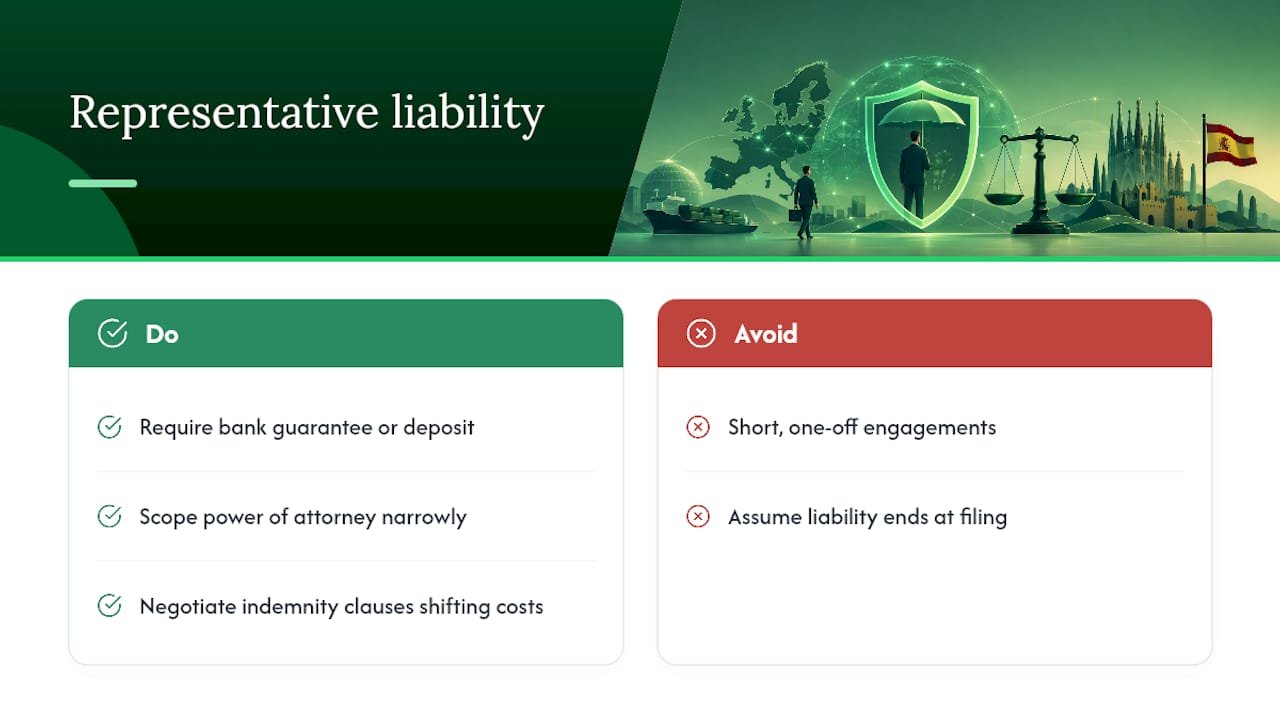
The exposure does not vanish the moment a filing period ends. Article 66 of Ley 58/2003, the General Tax Law, sets a four-year statute of limitations on tax assessments. That means a representative can face liability for periods filed years earlier, as long as AEAT stays within that four-year window from the relevant filing or assessment date. This is exactly why serious providers push back against short-term, one-off engagements. A representative who takes on your VAT registration for a single tax year is still exposed to that period for years after the relationship ends.
Providers manage this risk in a few consistent ways: requiring a bank guarantee or deposit before onboarding, scoping the power of attorney narrowly rather than granting blanket authority, and negotiating indemnity clauses into the engagement contract that shift the ultimate cost of an error or a client’s non-payment back to the client. None of this is legal advice specific to your situation. It’s simply how the market prices and contains a real liability that the statute itself creates.
How to Appoint a Fiscal Representative in Spain
The appointment process is mechanical once you understand the sequence, but the two most common bottlenecks are document legalization and digital certificate setup, both of which can add weeks if you start late.
- Gather your corporate documents. Certificate of incorporation, proof of legal representative identity, and basic KYC documentation, all translated by a sworn translator if not already in Spanish.
- Legalize the power of attorney. Execute it before a Spanish notary if you can travel, or before a Spanish consulate in your home country with an apostille attached under the Hague Convention. The POA should explicitly cover VAT, IRNR, and withholding tax matters so the representative isn’t left without authority on one of them.
- Register with AEAT using Form 036. This census filing obtains your Spanish NIF (tax ID) and formally registers the representation. It is the same procedure AEAT’s own guidance describes for census and representation filings.
- Set up an FNMT digital certificate. Electronic filing in Spain runs through the Fábrica Nacional de Moneda y Timbre certificate system. Without it, your representative cannot submit returns electronically, which is how nearly everything gets filed now.
- Notify Spanish payers and arrange direct debit. Any Spanish counterparties withholding tax on your behalf need your new fiscal details, and you’ll want a Spanish bank arrangement ready for payments AEAT expects on schedule.
Pro Tip: Submit complete, already-apostilled document copies on the first pass, and agree the exact registration scope with your representative before Form 036 goes in. Reworking a submission because a document was missing or the POA scope was too narrow is the single most common cause of onboarding delays, according to BMC’s guidance on non-resident fiscal representation.
Which Returns Does the Representative File?
For VAT, expect Form 303 filed periodically (monthly if your turnover crosses the SII threshold, quarterly otherwise), Form 390 as the annual summary, and Form 349 for EC Sales List reporting if you’re moving goods within the EU. Businesses over roughly €6 million in turnover fall under the SII (Immediate Supply of Information) regime, which requires invoice records uploaded to AEAT within four business days and exempts you from filing Form 390 in exchange for that faster cadence.
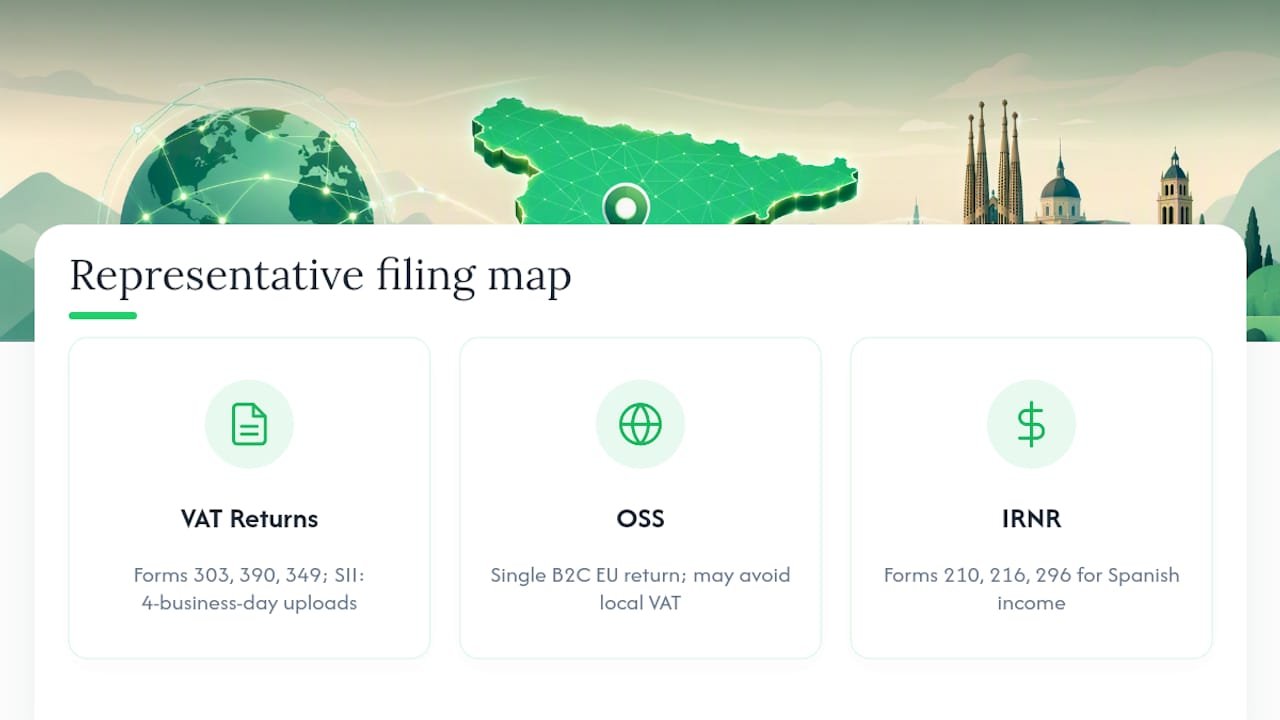
Cross-border e-commerce sellers need to understand where the One Stop Shop (OSS) fits. OSS centralizes B2C VAT reporting across EU member states through a single return, which can reduce or eliminate the need for local Spanish VAT registration depending on your sales pattern. It does not replace a fiscal representative requirement tied to physical presence, like stock held in a Spanish warehouse.
For non-resident individuals and companies with Spanish-source income outside standard VAT, Form 210 handles IRNR filings, commonly used for rental income and capital gains on Spanish property sales. Forms 216 and 296 cover withholding obligations tied to that income. Miss a deadline on any of these and AEAT applies interest plus surcharges that scale with how late the filing lands, on top of the joint liability exposure already sitting on the representative’s shoulders.
What Does Fiscal Representation Cost?
Fee models generally break into three layers: a one-time setup fee for the POA processing and AEAT registration, an annual retainer covering ongoing compliance monitoring, and per-return filing fees that scale with complexity. A business filing quarterly VAT with no SII or OSS involvement costs less than one juggling monthly SII uploads, OSS cross-border sales, and a property portfolio generating IRNR filings.
Because joint liability puts the representative’s own assets at risk, some providers ask for a bank guarantee or upfront deposit, particularly for higher-risk profiles like new importers with no filing history. When you review an engagement letter, check that it spells out the exact scope of representation, any limits on the representative’s liability exposure, response-time commitments for AEAT communications, and how often you’ll be billed.
How Do You End Fiscal Representation?
Ending the relationship cleanly starts with filing a cessation, or baja, through Form 036, which tells AEAT the representation has formally stopped as of a specific date. Before that date lands, file all outstanding returns and settle any pending liabilities. Loose ends here don’t disappear just because the relationship ended.
Liability for prior periods survives termination. The four-year statute of limitations under Ley 58/2003 still applies to everything filed while the representation was active. An outgoing representative should hand over complete records, formally notify Spanish payers of the change, and get written confirmation that AEAT has processed the cessation before considering the engagement closed.
How Law Cappital Handles Your Fiscal Representation
This firm builds fiscal representation around the full compliance cycle rather than a single filing. That starts with executing your power of attorney, moves through AEAT Form 036 registration and FNMT digital certificate setup, and continues with periodic filings handled on schedule.
Treaty-rate administration involves submitting an official fiscal residence certificate to Spanish payers and renewing it annually. Managing that renewal cycle and liaison with the payers withholding on Spanish income is part of the service.
Every engagement starts with a free initial consultation to map out which filings, forms, and deadlines apply before any contract is signed.
Why Compliance-First Beats Cheapest-Option Thinking
Most guides on fiscal representation treat it as a box-checking exercise: appoint someone, file the forms, move on. That framing undersells the actual risk. The joint-liability structure means the person you hire is exposed to your tax debts for four years after any given filing period closes. A representative who quotes the lowest fee and skips a bank guarantee or a tightly scoped power of attorney isn’t offering you a bargain. They’re likely underpricing their own risk, which tends to show up later as slower filings, weaker AEAT relationships, or, worse, a representative who quietly exits once a liability gets real.
The conventional advice online tends to stop at “here’s who needs a representative and here’s Form 036.” It rarely explains that the appointment is a legal relationship with genuine financial stakes on both sides, not a subscription service. If you take one thing from this guide, prioritize the scope of the power of attorney and the liability terms in the engagement letter over the sticker price. Everything downstream, from SII compliance to treaty-rate renewals, runs smoother when that foundation is built correctly the first time.
— Jorge
Get Your Spanish Fiscal Representation Set Up Correctly
This firm handles joint-liability exposure, treaty-rate paperwork, and AEAT correspondence to simplify managing Spanish tax bureaucracy from abroad. That matters most for non-EU companies juggling import VAT, FBA stock, or property income who need someone bilingual answering AEAT notices the same week they arrive, not weeks later after something gets lost in translation.

When you engage this service for fiscal representation, it includes:
- Power of attorney execution
- AEAT Form 036 registration and NIF acquisition
- FNMT digital certificate setup for electronic filing
- Periodic VAT and IRNR filings on schedule
- Treaty-rate residence certificate renewal and liaison with payers
Start with a free consultation through Lawcappital’s Spanish tax services page to map out exactly which filings and forms apply to your business before committing to anything.
This article is general information, not a substitute for advice from a qualified financial advisor. Consult a qualified financial professional about your own circumstances before acting on anything here.
Sources
- Representation and joint and several liability in the Non-Resident Income Tax (AEAT)
- Fiscal Representative in Spain | Commenda
- EU One-Stop Shop (OSS) guidance
Recommended
