
Qualify for Spain’s Beckham Law: 4 Pathways That Cut Denial Risk

You qualify for the Beckham Law if you haven’t been a Spanish tax resident in the past five years, your move to Spain is tied to a qualifying job, directorship, or entrepreneurial activity, and you won’t be earning income through a Spanish permanent establishment. If that’s you, file Modelo 149 within six months of registering with Spanish Social Security, then report annually using Modelo 151. Getting this wrong at the filing stage is where most denials happen, and firms like Law Cappital exist specifically to catch that.
TL;DR:
- Filing Modelo 149 within six months of Social Security registration is crucial; missing this deadline is a common cause of denial.
- Evidence must clearly show the employment contract predates the move, with no modifications after arrival, to satisfy causation requirements.
- Income above €600,000 is taxed at higher rates, and income earned before relocating or through a permanent establishment does not qualify for the flat rate.
- The regime’s duration is six years, after which applicants revert to standard progressive tax rates on worldwide income.
- Recent amendments in 2023 broaden eligibility for remote workers and entrepreneurs, but strict documentation and proper timing remain essential.
Table of Contents
- Beckham Law Eligibility Requirements You Need to Meet
- The Four Pathways Into the Regime and What Each Requires
- How to Apply: Modelo 149, Deadlines, and Modelo 151
- Which Income Counts, and What Doesn’t
- How Long the Regime Lasts and What Happens When It Ends
- Common Reasons Beckham Law Applications Get Denied
- Who’s Behind This Guide
- What the Rules Actually Reward, and What They Punish
- Get Help Applying for the Beckham Law
- Sources
Beckham Law Eligibility Requirements You Need to Meet
Spain’s special regime for inpatriates, laid out in Article 93 of the Personal Income Tax Law, runs on three tests. Miss any one of them and you’re filing under standard progressive rates instead of the flat 24%.
The first test is non-residence. Spain generally decides tax residency using the 183-day rule or by checking where your “center of vital interests” sits, but Beckham eligibility asks a narrower question: were you a Spanish tax resident at any point in the five years before your move? That look-back shrank from ten years to five when Article 93 was amended effective January 1, 2023, which opened the door to people who’d lived in Spain a decade earlier but had genuinely settled elsewhere since.
The second test is causation. Your relocation has to be driven by the qualifying activity, not the other way around. AEAT wants to see that the job came first and the move followed. Acceptable evidence includes an employment contract signed and dated before you set foot in Spain, or formal posting documentation if your employer transferred you here. Practitioners see a lot of borderline cases fail exactly here, because applicants show up first and only formalize the paperwork afterward. A dated contract or posting letter tends to be the deciding document in these disputes.
The third test involves permanent establishment. If you’re earning income through a Spanish permanent establishment (PE), meaning a fixed place of business you operate here that generates income independently of your foreign employer, that income disqualifies you from the special regime. This matters most for consultants and business owners who might structure part of their work through a Spanish entity without realizing the tax consequence.
Beyond the three core tests, a few structural details shape who actually benefits:
- Family inclusion: your spouse or registered domestic partner and any children under 25 (or of any age if disabled) can join the regime, provided their own income stays below yours and they meet the same non-residence look-back.
- Startup and remote-work expansion: Ley 28/2022, Spain’s Startups Law, broadened eligibility to cover digital nomads, certified entrepreneurs, and startup founders who previously fell outside the traditional employee or director categories.
- Director ownership limits: company administrators generally face a 25% ownership cap tied to how the company is classified, though ENISA-certified startups get an exception.
- Activity location flexibility: the 2023 changes explicitly recognized remote work performed for foreign employers as a qualifying pathway, not just traditional in-country employment.
The 2023 amendment to Article 93 is the reason this regime now fits so many more relocation profiles than it did a few years ago. If you were rejected or discouraged before 2023, it’s worth checking again.
The Four Pathways Into the Regime and What Each Requires
Most applicants fall into one of four categories, and each one has its own evidence profile.
- Traditional employment or posting. You need an offer letter, a signed work contract predating your arrival, payroll records once employment begins, and, if you were transferred by your existing employer, a formal posting agreement. AEAT expects the paper trail to show the job existed before you crossed the border, not after.
- Company administrator. If you’re moving to run a Spanish subsidiary or take a board seat, ownership thresholds come into play. Directors typically can’t hold 25% or more of a company classified as passive or asset-holding, though this cap loosens for entrepreneurs backed by ENISA certification. AEAT will review corporate statutes, shareholder registries, and financial statements to confirm the company is genuinely operating a business.
- Remote work and digital nomad status. This route, formalized by the 2023 changes, covers people who keep their foreign job but relocate to Spain. You’ll need your digital nomad visa or residence permit, proof your employer is based outside Spain, and documentation showing your work remains principally directed at that foreign employer rather than Spanish clients.
- Entrepreneur or startup founder. This pathway requires certification of your entrepreneurial project, typically through the channels the Startups Law created, along with evidence the venture involves genuine innovation and business activity rather than a shell structure.
Pro Tip: Whichever route applies to you, gather your dated contract, visa, or certification documents before you file, not after. AEAT reviewers flag applications where the paperwork trail looks assembled retroactively, and that alone can trigger a request for more evidence or an outright denial.
How to Apply: Modelo 149, Deadlines, and Modelo 151
The clock starts the day you register with Spanish Social Security, not the day you arrive or the day you sign your contract. From that registration date, you have six months to file Modelo 149, the form that formally opts you into the special regime. Miss that window and you generally lose the chance to apply for that tax year.
Before you can even get to that step, you’ll need an NIE (foreigner identification number), which you can request through Spanish consulates abroad or in-country offices once you arrive. Social Security registration typically follows once your employer or your own business activity is set up.
A few practical notes on Modelo 149 itself:
- It must include accurate identification of your employer or the qualifying activity, your NIE, and your Social Security registration details.
- Common rejection triggers include incomplete employer information, missing dates, or a registration date that doesn’t line up with the stated filing deadline.
- Filing happens through AEAT’s electronic portal, and most documentation is accepted as digital scans, though originals may be requested later.
Once you’re inside the regime, the annual obligation switches from the standard Form 100 (the regular IRPF return) to Modelo 151, a specific return built for special-regime taxpayers. The two forms ask for different things, and using the wrong one is a documented source of filing errors.
Which Income Counts, and What Doesn’t
The regime taxes employment income at a flat 24% up to €600,000 for the tax year. Above that threshold, the excess is taxed at 47%, a detail that surprises high earners who assume the flat rate applies without limit.
Not everything you earn falls under this favorable rate, though. A few categories sit outside the regime entirely:
- Income you earned before your actual relocation date doesn’t qualify, even if it lands in a Spanish bank account after you arrive.
- Income attributed to a Spanish permanent establishment is excluded, which circles back to why the PE test matters so much at the eligibility stage.
- Secondary consultancy work performed for Spanish clients through a fixed local setup can complicate your status if it starts to resemble a PE.
The flat 24% ceiling matters more than most applicants realize going in. A director earning €900,000 a year isn’t paying 24% across the board. The first €600,000 gets the favorable rate; the remaining €300,000 lands at Spain’s top marginal rate. Run the math before you assume this regime solves your entire tax picture.
AEAT has also generally tolerated remote work performed outside Spain for short stretches, as long as the core of your qualifying activity stays anchored to the reason you relocated in the first place.
How Long the Regime Lasts and What Happens When It Ends
The special regime covers your arrival year plus five additional tax years, six years total. During that stretch, you keep the flat 24% rate on qualifying employment income up to €600,000, a clear advantage over Spain’s progressive IRPF brackets, which climb well past 40% for high earners.
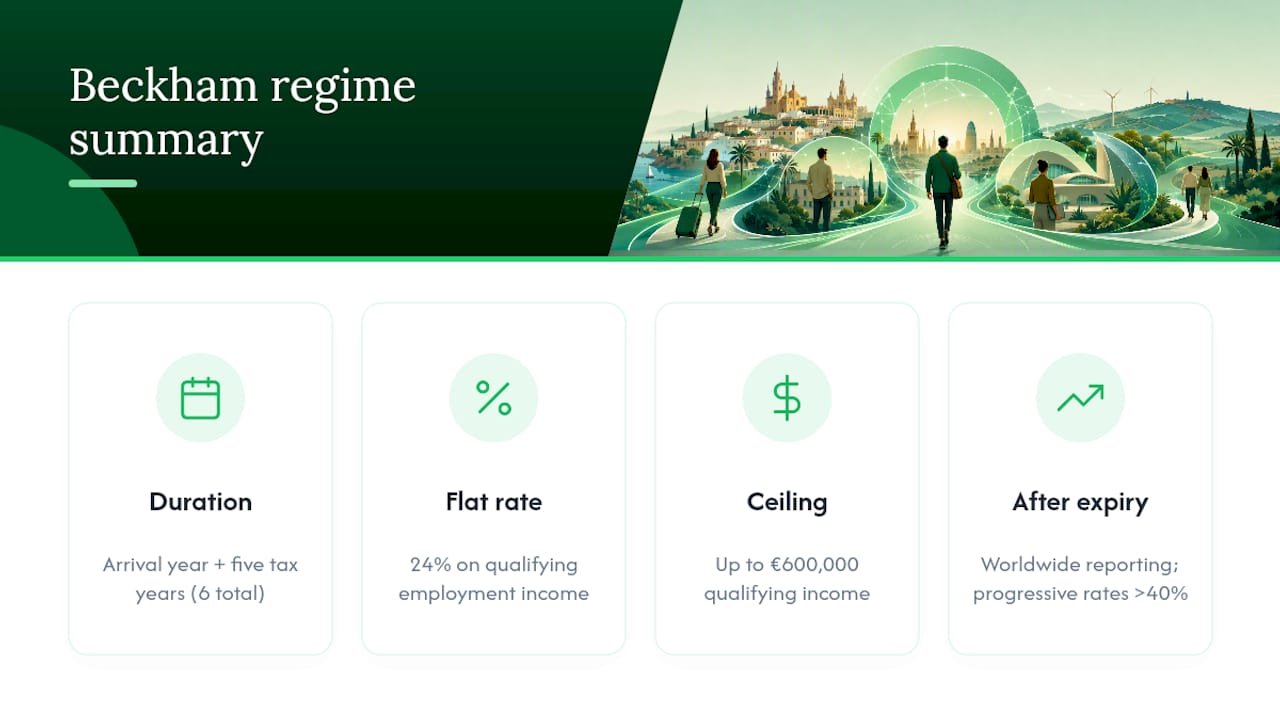
You’ll file Modelo 151 every year you’re in the regime. If your circumstances change, say you stop meeting the qualifying-activity requirement, or you take on a role that no longer fits the original approval, the regime can end early.
When the six years run out, you revert automatically to standard tax residency rules the following year. That means worldwide income reporting and progressive rates kick in, so it’s worth planning ahead for the jump rather than being caught off guard when year seven arrives.
Common Reasons Beckham Law Applications Get Denied
Most denials trace back to documentation gaps rather than genuine ineligibility. Before you submit, make sure you can produce:
- A signed employment contract or offer letter dated before your relocation
- Proof of Social Security registration with a clear date
- Payroll records once employment begins
- Posting letters, if applicable, from your transferring employer
- Company statutes and shareholder records, if you’re applying as a director
- ENISA or startup certification documents, if that’s your qualifying pathway
The most frequent mistakes are surprisingly avoidable. Filing Modelo 149 after the six-month deadline is the single biggest self-inflicted error. Unclear causation evidence, meaning a contract that doesn’t clearly predate the move, is another. And directors sometimes get tripped up by misclassifying their own company as an active business when AEAT’s review of the balance sheet suggests it’s really an asset-holding vehicle, which triggers the 25% ownership cap instead of the exception.
Pro Tip: When your facts sit in a gray area, such as a company with mixed active and passive income, consider requesting a consulta vinculante, a binding ruling from Spain’s General Directorate of Taxes (DGT). It costs time upfront but removes the guesswork before you commit to a filing.
Who’s Behind This Guide
This guide draws on the practical experience of Jorge Lacasa Alesón, Managing Partner at Law Cappital, a Madrid-based firm focused on tax, immigration, and corporate law for foreigners relocating to Spain. The firm handles Beckham Law applications, digital nomad visa coordination, and cross-border tax matters, including the double-taxation questions that come up constantly for US expats moving to Spain. Complex cases, company directors near the ownership threshold, startup founders needing certification, dual-filing Americans, are where specialist representation tends to matter most.
What the Rules Actually Reward, and What They Punish
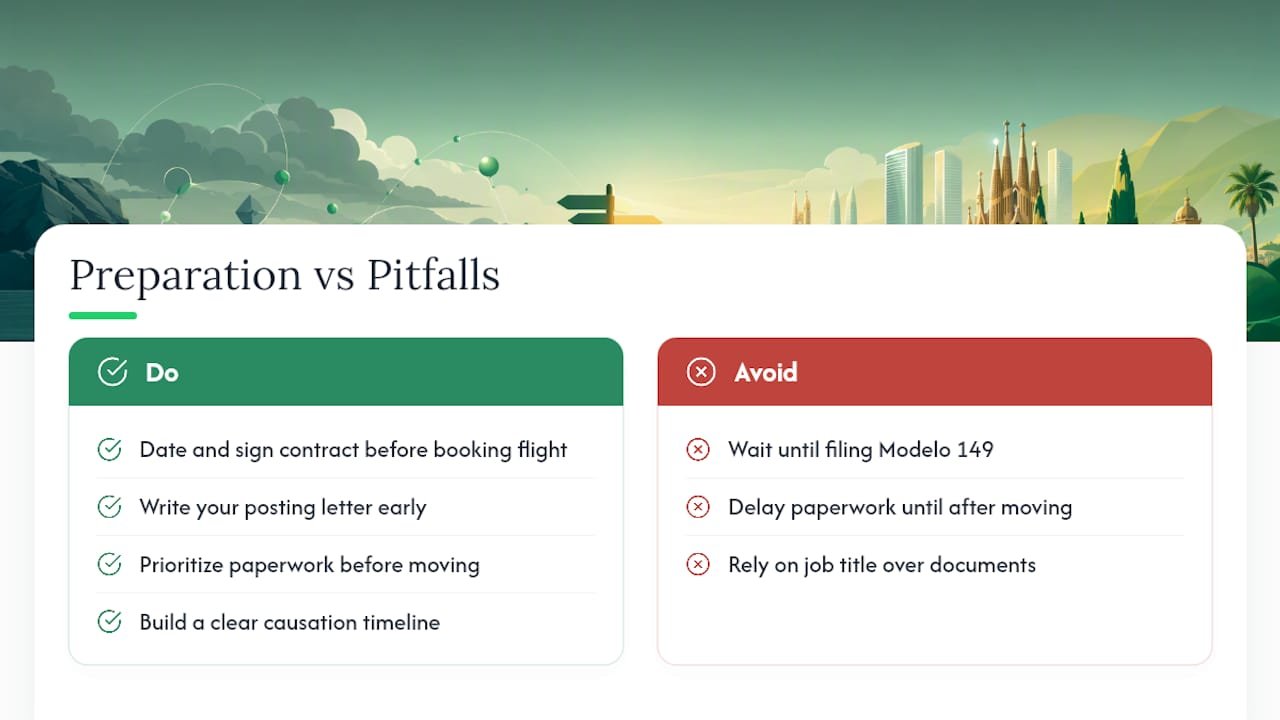
The Beckham Law rewards preparation, not ambition. The applicants who sail through are the ones who had their contract dated and signed before they booked a flight, not the ones with the most impressive job title. That’s the part conventional advice glosses over: it treats eligibility as a status you either have or don’t, when in practice it’s a paper trail you either built correctly or didn’t.
The 2023 expansion gets talked about as a headline win for digital nomads and founders, which it is, but the real shift is quieter. It made the causation test the central battleground. Before, most applicants were traditional employees with an obvious sequence of events. Now that remote workers and entrepreneurs qualify too, the timeline between “decided to move” and “started the qualifying activity” gets scrutinized harder, because there’s more room for it to look backward.
If you’re relocating for work, prioritize the paperwork before the paperwork feels necessary. Get the contract dated. Get the posting letter written. Don’t wait until you’re filing Modelo 149 to realize you have a causation problem you can’t fix retroactively.
— Jorge
Get Help Applying for the Beckham Law
Working through five years of residency history, causation evidence, and permanent establishment rules on your own is where most self-filed applications run into trouble. Specialized legal firms review your specific situation, whether you’re an employee, a director, or a startup founder, and build the documentation AEAT expects to see before you file, not after a rejection forces a second attempt.
If you’re weighing whether your case fits one of the four pathways, or you need someone to check your Modelo 149 timeline before the six-month clock runs out, book a consultation to apply for the Beckham Law with Law Cappital’s team in Madrid. For broader cross-border tax questions tied to your move, the firm’s Spanish tax services page covers the wider planning picture beyond the special regime itself.
This article is general information, not a substitute for advice from a qualified financial advisor. Consult a qualified financial professional about your own circumstances before acting on anything here.
Sources
- AEAT procedural guidance (Modelo 149 / opt-in communications)
- Beckhamlaw
- Beckham Law in Spain: Tax Regime for Expats and Impatriates – Radar Fiscal
Recommended
