
Plan for $4,300–$10,600: Digital Nomad Visa Costs and Spain Tax
The consular fee is the smallest number on your budget sheet. Total first-year cost typically runs widely depending on country and included services, with lower costs for destinations like Georgia or Colombia with minimal fees and cheaper living, and higher costs for moves to Spain or Portugal when accounting for insurance, translations, apostilles, and legal coordination. Application fees alone range from $0 to over $1,200, income thresholds run $1,100 to $4,000 a month depending on the country, and hidden costs typically add $500 to $3,000 on top. Spain and Mexico draw the most questions, and both reward careful planning around income proof and tax residency, not just the sticker price of the application.
TL;DR:
- Digital nomad visa application fees range from $0 to over $1,200, but ancillary costs like translations, apostilles, and insurance often double the initial budget.
- Income verification methods include bank statements, contracts, or tax returns, with requirements varying by consulate and often needing certified translations.
- Long-term tax costs can outweigh the initial visa fee, especially in countries like Spain with high progressive rates versus territorial tax regimes like Costa Rica or Croatia.
- Processing times typically span four to twelve weeks and can be delayed by improper documentation, unnotarized or untranslated files, or overlooked apostille steps.
- Budgeting accurately for a move requires considering all hidden fees, preparations for tax implications, and understanding the interaction between visa requirements and long-term residency costs.
Table of Contents
- What Does a Digital Nomad Visa Cost Actually Include?
- How Much Do Digital Nomad Visas Cost by Country?
- What Hidden Fees Should You Budget for Beyond the Application?
- How Do Consulates Verify Your Income for a Digital Nomad Visa?
- Why Does Your Tax Situation Determine the Real Cost of a Visa?
- How Long Does Digital Nomad Visa Processing Actually Take?
- What Do Two Real First-Year Visa Budgets Look Like?
- When Does a Visa Decision Become a Tax Decision?
- How Lawcappital Helps You Plan a Move to Spain
- Sources
What Does a Digital Nomad Visa Cost Actually Include?
Most people price a digital nomad visa by looking up one number: the application fee. That number is almost never the real cost of the move.
A useful way to think about it is four separate line items, a framework several visa guides now use because it maps to how consulates actually evaluate applications: the application fee, the income requirement, living costs, and ongoing tax obligations. Each behaves differently, and confusing them is where budgets go wrong.
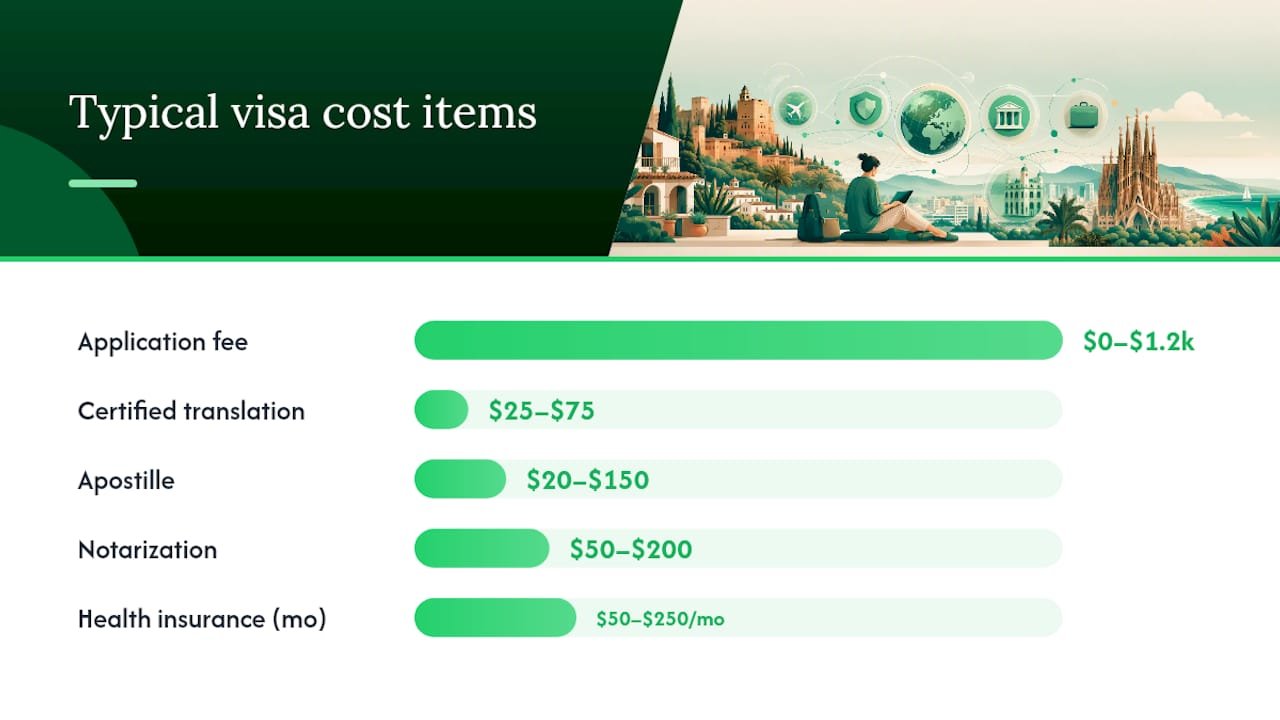
The application fee is a one-time payment to the consulate or immigration authority, usually $0 to $1,200 depending on nationality and country. It buys you nothing but the right to have your file reviewed.
The income requirement is not a fee at all. It is a threshold you have to prove you already clear, usually through bank statements, contracts, or tax returns. You don’t pay this amount to anyone; you demonstrate it exists. Confusing a minimum income requirement with a payable cost is the single most common budgeting mistake first-time applicants make.
Ancillary costs are where budgets quietly blow up. These include:
- Certified translations of birth certificates, marriage certificates, and background checks, often $25 to $75 per document.
- Apostille certification through your home state or country, typically $20 to $150 depending on jurisdiction and turnaround speed.
- International or local private health insurance, generally $50 to $250 a month depending on age and coverage level.
- Notarization of powers of attorney or supporting affidavits, often $50 to $200.
- Courier fees for sending original documents to a consulate that doesn’t process in person.
Tax obligations are the piece almost nobody prices upfront, and the one that determines whether a visa is cheap or expensive over a five year horizon. A country with a $500 application fee but no favorable tax regime can cost you far more by year three than a country with an $800 fee and a flat-rate tax option.
Before you apply anywhere, price out five things: the consular fee for your nationality, the cost of certified translations for every civil document you’ll submit, an insurance quote that meets the country’s minimum coverage, apostille fees at your home state’s rate and a rough estimate of what you’ll owe in taxes locally versus at home. That fifth item is the one people skip, and it’s usually the biggest number on the list.
How Much Do Digital Nomad Visas Cost by Country?
Fees shift often. Consulates update pricing for reciprocity reasons and currency movement, and some fee schedules change quarterly, so treat every number below as a planning estimate and confirm against the processing consulate before you file.
Spain anchors its income requirement to the national minimum wage, known as the SMI. For 2026, the SMI sits at €1,221 a month, and a single applicant must show 200% of that figure, roughly €2,442 a month. That threshold rises for each dependent added to the application. The visa itself runs for one year initially, renewable up to five years, after which permanent residency becomes possible. Application fees vary by consulate and nationality, and Spain’s consular fee tables list different amounts for applicants from the United States, United Kingdom, and other countries. Monthly living costs outside Madrid and Barcelona typically land between $1,200 and $1,800 for a single person. The standout feature isn’t the fee; it’s that qualifying remote workers can apply for Spain’s Beckham Law regime, which taxes foreign employment income at a flat 24% up to €600,000 rather than Spain’s progressive scale.
Mexico doesn’t run a dedicated “digital nomad visa” by that name. Remote workers typically use the Temporary Resident visa pathway, which grants stays from six months up to four years depending on the term requested. Consular fees and posted income thresholds vary meaningfully by consulate, and applicants should check with the specific Mexican consulate handling their case since requirements aren’t uniform nationwide. The Instituto Nacional de Migración publishes the official forms and documentation checklists, which is worth bookmarking before you start gathering paperwork. Living costs in cities like Mexico City or Playa del Carmen run roughly $1,000 to $1,800 a month, lower in smaller towns. Mexico does not tax foreign source income for temporary residents who maintain their tax home elsewhere, which keeps the long-term cost calculation relatively simple compared to Spain.
Portugal’s D8 visa uses a flat income figure tied to the Portuguese minimum wage rather than Spain’s percentage-based SMI model, requiring roughly four times the national minimum wage in monthly income, which typically lands near $3,500 depending on annual wage updates. Application costs run in the low hundreds of dollars, and the visa grants a one-year residency permit renewable for two-year periods, eventually opening a path to permanent residency after five years. Lisbon living costs have climbed sharply, often $1,500 to $2,200 monthly, while smaller cities like Coimbra or Braga run notably cheaper. Portugal’s former Non-Habitual Resident tax perks have been curtailed for many new applicants, so anyone counting on a Portuguese tax break should verify current eligibility rather than assume the old rules still apply.
Croatia offers one of the more budget-friendly EU options. The application fee is modest, often under $100, and the income threshold is roughly €2,540 a month for a single applicant, adjusted periodically. The permit runs for up to a year and is not directly renewable. You have to leave for six months before reapplying, which is unusual among these programs and worth factoring into any multi-year plan. Zagreb and coastal cities like Split run $1,000 to $1,600 monthly for a single person. Croatia does not tax foreign income earned under this visa category, a meaningful advantage for anyone whose income already gets taxed at home.
Greece sits on the pricier end of the fee spectrum, with digital nomad visa costs that can run several hundred dollars for the applicant and add up quickly with dependents. The income requirement is roughly €3,500 a month for a single applicant. The visa lasts one year and is renewable, converting into a two-year residence permit. Athens living costs run moderate by Western European standards, often $1,300 to $1,900 monthly, with islands and smaller cities considerably cheaper outside peak tourist season. Greece offers a 50% tax reduction on employment income for qualifying new tax residents for up to seven years, a benefit worth pricing against Spain’s Beckham Law if you’re weighing both.
Georgia remains one of the cheapest entry points in this category. There’s no formal fee for its remote worker program in many cases, and the income requirement is comparatively low, often cited around $2,000 monthly, though applicants should verify current figures since Georgia has adjusted its remote-work program terms more than once. The permit typically runs for a year. Tbilisi living costs are strikingly low, frequently $600 to $1,000 monthly for a comfortable single-person setup. Georgia’s territorial tax system means foreign source income generally isn’t taxed locally, which is a major reason it shows up on so many “cheapest digital nomad visa” lists.
Colombia’s digital nomad visa charges an application fee in the range of $40 to $50, among the lowest on this list, with an income requirement around three times the local minimum wage, translating to roughly $900 to $1,100 monthly. The visa runs for two years, a longer initial grant than most European options. Medellín and Bogotá living costs run $800 to $1,400 monthly for a single person. Colombia taxes worldwide income only after 183 days of residency in a 365 day period, which gives new arrivals a planning window worth discussing with a tax advisor before that clock runs out.
Costa Rica charges a modest application fee, typically under $200, against an income requirement of roughly $3,000 monthly for an individual, one of the higher thresholds among Latin American options. The permit lasts one year, renewable for a second year. San José and the Central Valley run $1,200 to $1,800 monthly, while Pacific coast towns can run considerably higher due to expat demand. Costa Rica’s territorial tax system exempts foreign source income from local taxation, making it a genuine low-tax option despite the steeper income bar.
The UAE digital nomad visa (commonly marketed as the virtual working program) charges a few hundred dollars in fees and requires proof of monthly income around $3,500 to $5,000, among the highest thresholds on this list. The permit runs for one year, renewable annually. Dubai living costs are steep, often $2,500 to $4,000 monthly for a comfortable single-person lifestyle, among the priciest destinations here. The UAE’s zero personal income tax is the entire pitch: no tax on foreign or local earnings, which can offset the higher cost of living for higher earning remote workers.
| Country | Application fee | Minimum monthly income | Duration/renewal | Rough monthly living cost | Tax note |
|---|---|---|---|---|---|
| Spain | Varies by consulate/nationality | ~€2,442 (200% SMI) | 1 year, renewable to 5 | $1,200–$1,800 | Beckham Law: flat 24% option |
| Mexico | Varies by consulate | Varies by consulate | 6 months–4 years | $1,000–$1,800 | No tax on foreign income for temp residents |
| Portugal | Low hundreds ($) | ~$3,500 | 1 year, renewable | $1,500–$2,200 (Lisbon) | NHR benefits reduced; verify eligibility |
| Croatia | Under $100 | ~€2,540 | Up to 1 year, not directly renewable | $1,000–$1,600 | No tax on foreign income |
| Greece | Several hundred ($) | ~€3,500 | 1 year, renewable to 2 | $1,300–$1,900 | 50% tax reduction for 7 years |
| Georgia | Often free | ~$2,000 (verify current) | ~1 year | $600–$1,000 | Territorial tax system |
| Colombia | ~$40–$50 | ~$900–$1,100 | 2 years | $800–$1,400 | Worldwide income taxed after 183 days |
| Costa Rica | Under $200 | ~$3,000 | 1 year, renewable to 2 | $1,200–$1,800 | Territorial tax exemption |
| UAE | Few hundred ($) | ~$3,500–$5,000 | 1 year, renewable | $2,500–$4,000 | Zero personal income tax |
What Hidden Fees Should You Budget for Beyond the Application?
The application fee rarely tells you what a visa actually costs to obtain and maintain. Budget for these in order:
- Document translation and certification. Every civil document not already in the destination country’s language needs a certified translation, typically $25 to $75 per page, plus notarization in some jurisdictions.
- Apostille certification. Your home state’s Secretary of State or equivalent authority charges $20 to $150 per document, with expedited service costing more.
- Health insurance. Most programs require private coverage meeting a minimum sum insured, usually running $50 to $250 monthly depending on age and plan depth.
- Residency card issuance and local registration. Once you land, expect administrative fees for the physical residency card, local municipal registration, or biometric appointments, often $50 to $300.
- Consulate logistics. Appointment fees, courier costs for returning passports, and travel to a consulate if you don’t live near one can add $100 to $500 depending on distance.
- Professional or legal fees. Complex situations, dual income sources, family applications, or tax residency questions often justify hiring a specialist, with fees ranging from a few hundred dollars for document review to several thousand for full-service application and tax coordination.
That last item pays for itself more often than people expect. A rejected application because of a formatting error on a bank statement costs you the consulate fee again, plus months of delay. A tax residency mistake in your first year can cost thousands more than the legal fee would have.
Pro Tip: Get insurance quotes before you finalize your target country. Some countries specify minimum coverage amounts that rule out budget travel policies, and discovering that after you’ve already paid translation fees wastes both time and money.
How Do Consulates Verify Your Income for a Digital Nomad Visa?
Income verification methods split into two broad models. Spain’s approach ties the requirement to a percentage of the national minimum wage, meaning the number moves whenever the SMI is updated. Portugal and most other countries instead post a flat figure, updated periodically but not automatically tied to a wage index.
Consulates typically accept a mix of the following as proof:
- Bank statements covering the last three to six months, showing consistent deposits.
- Signed employment contracts or a retainer letter from a client, especially for freelancers without a single employer.
- Recent tax returns showing annual income at or above the required threshold.
- Invoices issued to clients over the past several months, useful for freelancers who bill project by project rather than drawing a salary.
Formatting matters more than applicants expect. Documents typically need to cover a specific period (often the three to six months immediately preceding the application), and anything not in the local language needs a certified translation attached. Some consulates want notarized copies rather than originals; others want the reverse.
Requirements shift by consulate even within the same country, and the only reliable way to confirm current paperwork is calling or emailing the specific office handling your file. Freelancers should lean on a combination: three months of bank statements plus at least one retainer letter or standing contract, since a single income document rarely satisfies every consulate’s underwriting instinct.
Why Does Your Tax Situation Determine the Real Cost of a Visa?
The visa fee you pay once. The tax rate you pay every year you stay. Over a three to five year horizon, tax treatment usually outweighs every other cost line combined, which is why evaluating multi-year tax effects rather than just the application fee matters more than shopping for the cheapest consular stamp.
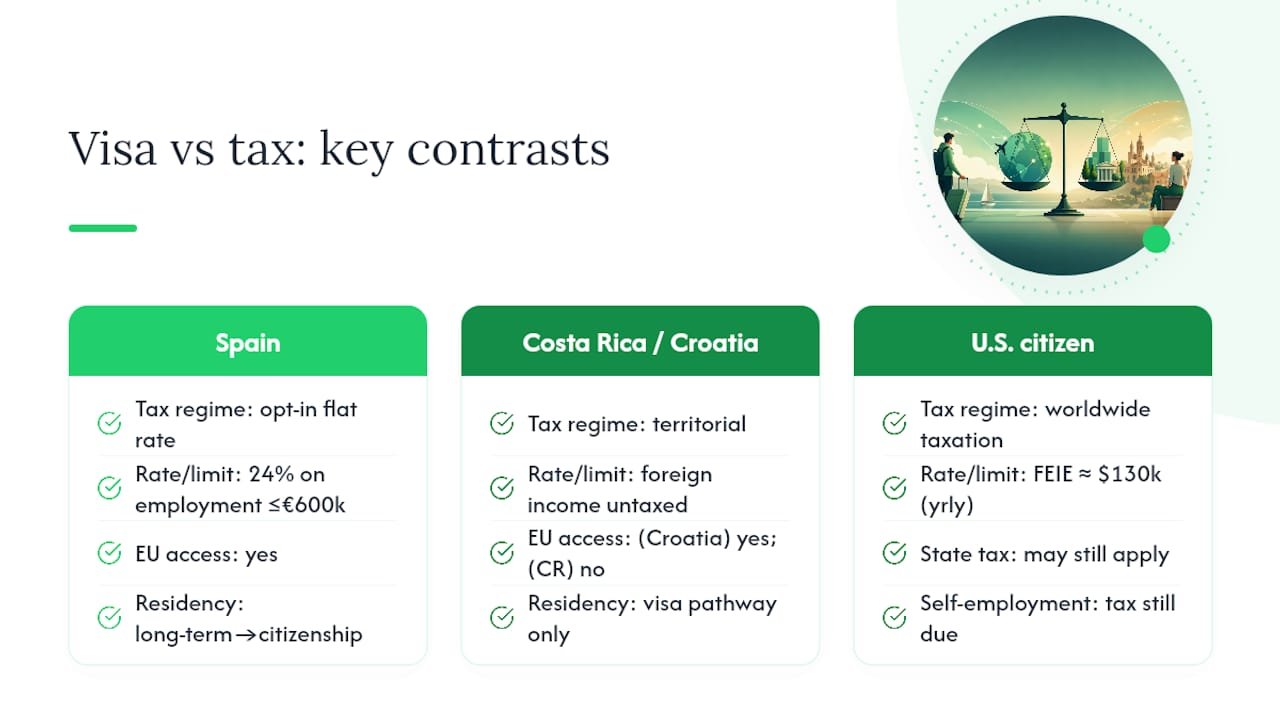
Spain’s Beckham Law is the clearest example of a visa where the sticker price undersells the value. Qualifying foreign workers who become Spanish tax residents can elect to pay a flat 24% rate on employment income up to €600,000, instead of Spain’s standard progressive scale that climbs past 45% at higher brackets. For a remote worker earning $150,000 a year, that election alone can be worth tens of thousands of dollars annually compared to ordinary Spanish tax residency.
The nominal income threshold on a visa application tells you almost nothing about what you’ll actually owe in tax three years into your residency. A country with a higher upfront requirement and a favorable flat-rate regime frequently beats a cheaper visa with standard progressive taxation, once you run the numbers past year one.
Costa Rica and Croatia take a different approach: territorial taxation means foreign source income simply isn’t taxed locally, full stop, for qualifying visa holders. That’s a simpler calculation than Spain’s opt-in regime, but it doesn’t offer the same EU market access or long-term residency pathway toward citizenship that Spain provides.
American citizens carry an extra layer regardless of destination. The United States taxes worldwide income no matter where you live, so U.S. citizens abroad still file annually and typically rely on the Foreign Earned Income Exclusion to shield roughly the first $130,000 (adjusted yearly) of foreign earned income from U.S. tax. That exclusion doesn’t eliminate state tax obligations for people who maintain domicile in certain states, and it doesn’t cover self-employment tax, which continues to apply to freelancers regardless of where they live.
The practical decision rule: if you’re comparing a $500 fee country with standard taxation against an $800 fee country offering a flat-rate election like Spain’s, run the tax math over three years before deciding. The $300 fee difference is often trivial next to a 20 point difference in effective tax rate. Anyone weighing this tradeoff for Spain specifically should look closely at how visa status interacts with tax residency before filing, since the two questions get decided together, not separately.
How Long Does Digital Nomad Visa Processing Actually Take?
Processing windows range from four to twelve weeks for most programs, though consulates handling high application volumes, especially Spain’s consulates in the U.S. and UK during peak spring and summer months, can stretch well past that. Fees themselves aren’t static either. Several consulates adjust posted amounts quarterly to reflect exchange rate movement or reciprocity arrangements with the applicant’s home country, so a fee you researched in January might be different by the time you file in June.
Common mistakes that trigger delays or outright rejections:
- Submitting bank statements that don’t cover the exact period the consulate requires, often the trailing three or six months.
- Skipping certified translation on a document the consulate explicitly requires in the local language.
- Missing an apostille on a document that needs one, a step people frequently assume applies only to certain document types.
- Applying with income documentation that shows irregular deposits without an accompanying explanation or contract.
- Underestimating how long apostille processing takes at the state level, sometimes four to eight weeks in high volume states.
Book a consultation with a local immigration specialist when your situation includes anything nonstandard: self-employment income spread across multiple clients, a family application with dependents, or a country whose requirements have changed recently and aren’t yet reflected in the guides you’ve been reading online. The Italian digital nomad visa program is a good example of a country where requirements have shifted enough in recent cycles that older blog posts can mislead applicants who don’t check the current consular posting.
What Do Two Real First-Year Visa Budgets Look Like?
Building your own number starts with six steps, each mapped to a rough dollar range:
- Confirm the application fee for your specific nationality and consulate, not a generic country average.
- Price certified translations for every civil document you’ll need, typically $25 to $75 each.
- Get an apostille quote from your home state, usually $20 to $150 per document.
- Get a compliant health insurance quote meeting the destination’s minimum coverage, generally $50 to $250 monthly.
- Estimate three months of local living costs as a cash buffer, since most programs require proof of sustained funds.
- Add a 15 to 20% contingency for currency swings and unexpected fees, a margin worth building in given how often fee schedules shift with exchange rates.
Sample Budget A, low-cost route (Georgia): Application fee near $0, translations and apostilles around $300, insurance at $100 monthly ($1,200 annually), three months of living costs at $800 monthly ($2,400), contingency of roughly $400. Total: approximately $4,300 for the first year.
Sample Budget B, EU residency route (Spain): Application and consular fees roughly $200 to $600 depending on nationality, translations and apostilles around $500 given the volume of civil documents Spain requires, insurance at $150 monthly ($1,800 annually), three months of living costs at $1,500 monthly ($4,500), legal and tax coordination fees for Beckham Law application and residency planning running $1,500 to $3,000, and a contingency of $600. Total: roughly $9,000 to $10,600 for the first year, hidden costs like translations and registration often adding $500 to $3,000 beyond the base fee alone.
The gap between those two budgets isn’t really about the consular fee. It’s about EU market access, a longer-term residency pathway, and a tax regime worth paying for legal coordination to access properly.
When Does a Visa Decision Become a Tax Decision?
A visa application stops being an immigration question and becomes a tax question the moment your income crosses a threshold where Spain’s standard progressive rates and the Beckham Law’s flat 24% produce a meaningfully different annual bill. For most remote workers earning above roughly $80,000, that gap is large enough to justify professional coordination before filing, not after arriving.
The issues that come up repeatedly aren’t exotic. They’re mismatches: someone files for tax residency without realizing they’ve triggered it earlier than planned under Spain’s 183-day rule, or a freelancer structures invoices in a way that complicates their Beckham Law eligibility, or a family application gets delayed because dependent income documentation wasn’t formatted the way a specific consulate wanted. Each of these is fixable with planning and expensive to unwind after the fact.
A first consultation typically does one job well: it scopes which visa route and tax election actually fit your income structure, family situation, and timeline, before you’ve spent money on documents you might not need or missed a filing window you didn’t know existed.
— Jorge
How Lawcappital Helps You Plan a Move to Spain
Lawcappital is the specialist route for anyone who wants their Spain visa application and their Spanish tax strategy coordinated from day one, rather than handled as two separate problems by two separate people later. The firm handles immigration filings, tax residency planning, and Beckham Law applications together, which matters because these three areas interact in ways that create expensive surprises when they’re managed in isolation.
A first consultation typically covers your income structure, family situation, and timeline, then scopes which visa pathway and tax election fit your case, with a clear estimate of fees and next steps before you commit to anything. That includes reviewing whether the Beckham Law’s flat 24% rate applies to your income type, mapping out your digital nomad visa application requirements for your specific nationality, and flagging how U.S. citizens can avoid double taxation between the two countries. If you’re comparing Spain against other countries, consider booking an initial consultation to better understand potential fees and tax implications before you file anything.
This article is general information, not a substitute for advice from a qualified lawyer. Consult a qualified legal professional about your own circumstances before acting on anything here.
Sources
- Telework (Digital nomad) Visa – Consular Section
- Temporary resident (consulmex)
- Instituto Nacional de Migración (Mexico)
Recommended
