
Nonresident Owners: Avoid 24% Imputed Tax on Modelo 210 Spain
If you own Spanish property as a non-resident and it earns rent, sits empty part of the year, or was recently sold, you almost certainly must file Modelo 210. Tax rates differ based on residency, with lower rates and deductions generally applying to EU/EEA residents and higher rates without deductions applying to non-EU residents. Figure out which income type applies to you, then either file online with a digital certificate or Cl@ve, or generate a paper pre-declaration if you lack electronic credentials.
TL;DR:
- Non-EU property owners pay higher tax rates without deductions, while EU/EEA residents can deduct costs like mortgage interest and repairs, lowering their tax burden.
- Imputed income applies annually to vacant or personally used properties based on cadastral values and can add hundreds of euros in tax, even without rental activity.
- Starting in 2026, the filing frequency shifts from quarterly to annual for rental and imputed income, requiring owners to adjust their filing calendar accordingly.
- Digital credentials are necessary for online filing; owners without them must generate paper pre-declarations and submit by mail or in person.
- Mistakes such as incorrect payment identifiers or missed deadlines are common triggers for penalties and can be costly if not corrected promptly.
Table of Contents
- Who Must File Modelo 210 and Which Incomes It Covers
- Tax Rates and Tax Base: EU/EEA vs Non-EU Ownership
- How Is Imputed Income Calculated for an Unused Property?
- Deadlines and the 2026 Filing Calendar Change
- How Do You Submit and Pay Modelo 210 From Abroad?
- Common Filing Errors That Trigger Penalties
- Can You Fix a Mistake After Filing Modelo 210?
- Does Filing Modelo 210 Affect Your Other Spanish Tax Obligations?
- Document Retention and Audit Risk for Non-Resident Filers
- When Should You Appoint a Tax Representative in Spain?
- When to Get Professional Help and What Law Cappital Can Do for You
- Credentials Behind This Guide
- Get Modelo 210 Filed Right, Without the Guesswork
- The Real Gap Between Modelo 210’s Rules and How People Actually File
- Sources
Who Must File Modelo 210 and Which Incomes It Covers
Modelo 210 is the Spanish tax return for non-residents earning income tied to Spanish territory, most commonly from real estate. If you live outside Spain for tax purposes and own property here, three income categories will likely require a filing at some point in the year.
Rental income comes first. Any rent you collect from a Spanish property gets declared, historically each quarter, though that rhythm is changing (more on that below). Imputed income applies even when nobody rents your place. Spain treats a vacant or personally used second home as generating a notional benefit to its owner, and taxes that phantom income annually. Capital gains round out the trio: sell a Spanish property, and the gain triggers a Modelo 210 filing regardless of how long you held it.
A few situations catch owners off guard:
- Letting a property for only part of the year still requires filing for the months it was rented, plus imputed income for the vacant months.
- Subletting arrangements where you’re not the legal owner but earn Spanish-source income can still trigger a filing obligation under different income codes.
- Prizes, royalties, and other Spanish-source payments to non-residents sometimes require Modelo 210 using specific codes distinct from the standard rental or imputed income boxes.
That withholding is not the final tax. You still must file Modelo 210 to declare the actual gain, and the buyer’s withholding is credited against what you owe. If the withholding exceeds your actual tax liability, filing is how you claim the difference back. The official Form 210 procedure page lists the income codes, country codes, and completion examples you’ll need to identify your exact case.
Tax Rates and Tax Base: EU/EEA vs Non-EU Ownership
The rate gap between residency categories is significant. EU/EEA residents pay tax on net rental income after allowable deductions, while non-EU residents pay tax on gross rental income without deductions.
That “net” distinction matters enormously in practice. EU/EEA owners can subtract allowable costs such as mortgage interest, local property tax, building insurance, repairs, management fees, and depreciation before the tax applies.
Quick comparison: Consider two property owners with the same rental income and costs. An EU resident generally has a lower tax burden than a non-EU resident due to deductions and different tax rates, illustrating how residency status affects Spanish tax bills markedly.
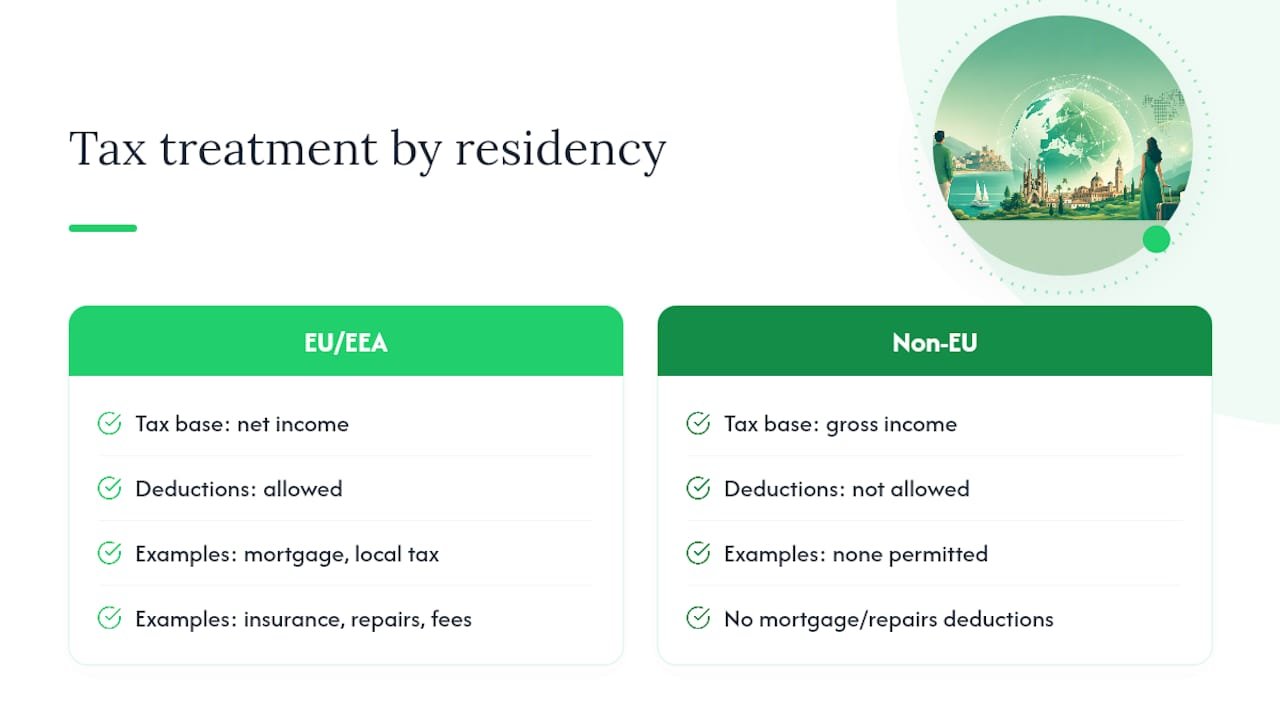
This is why residency status deserves attention before you even get to the filing mechanics. A non-EU owner who qualifies for EU residency through another route, or who structures ownership differently, can materially change this outcome. It’s also why some owners exploring long-term relocation look into options like the Beckham Law regime, which handles a separate tax situation but underscores how much Spanish residency status shapes your overall tax exposure.
How Is Imputed Income Calculated for an Unused Property?
Renta imputada catches more owners by surprise than any other part of Modelo 210, mainly because it applies whether or not you ever set foot in the property. Spain assumes an unused or personally occupied second home generates a benefit to its owner, and taxes that assumption annually.
The calculation runs on a simple formula:
- Take the cadastral value of the property (found on your IBI bill).
- Apply the appropriate multiplier depending on whether the cadastral value has been revised recently, as specified by Agencia Tributaria guidelines.
- Multiply by the fraction of the year the property sat unrented (days of personal use or vacancy ÷ 365).
- Apply your rate, 19% for EU/EEA residents or 24% for non-EU residents, to that resulting base.
Here’s how that plays out for two owners with an identical property, cadastral value of €200,000, not revised in the last decade, empty and unrented for the full year:
- EU owner: €200,000 × 2% = €4,000 taxable base. Tax due: €4,000 × 19% = €760.
- Non-EU owner: Same €4,000 base. Tax due: €4,000 × 24% = €960.
Pro Tip: *Check your IBI receipt or your municipal cadastre record for the exact revision date before you calculate.
Owners who both rent and personally use a property in the same year owe imputed income for the personal-use months and rental income tax for the rented months. They’re not mutually exclusive.
Deadlines and the 2026 Filing Calendar Change
For years, non-resident landlords filed rental income Modelo 210 quarterly, within the first 20 days of April, July, October, and January, while imputed income has always been an annual filing due by December 31 of the following year. That quarterly grind meant four separate submissions a year just for rental activity.
That changes under Order HAC/623/2026, which shifts the grouping for imputed income and income from leased or subleased properties toward annual reporting rather than the old quarterly split. The official Agencia Tributaria note on the modification lays out exactly which income types are affected and the transition timing.
What this means practically: fewer separate filings per year for many rental-income owners, but also a real risk of missing the new consolidated window if you’re used to the old quarterly rhythm.
- Confirm your specific income type’s current deadline directly on the Agencia Tributaria site before filing, since the transition affects categories differently.
- Set a calendar reminder well ahead of the annual deadline rather than relying on memory of the old quarterly pattern.
- If you use a gestor or tax representative, ask them explicitly whether your filing frequency changed under the new order.
If you own property in multiple EU jurisdictions, tracking varying deadlines across countries is its own headache. Resources like this overview of annual accounting deadlines in Bulgaria show how differently each country structures its calendar, which is worth keeping in mind if you’re managing property across borders.
How Do You Submit and Pay Modelo 210 From Abroad?
Filing runs through one of two channels, and which one fits you depends entirely on whether you hold Spanish digital credentials.
Online filing works if you have an electronic certificate, Cl@ve, or an eIDAS-recognized credential from another EU country:
- Log in to the Agencia Tributaria portal with your certificate, Cl@ve, or eIDAS identification.
- Complete the declaration fields, income type, accrual period, taxable base, and applicable rate.
- Run the “Validate declaration” check before submitting, since this catches most formatting and field errors automatically.
- Choose your payment method: generate an NRC (a bank-issued payment reference) if paying by card or bank transfer within Spain, or set up direct debit from a SEPA/EU account.
- Submit the validated declaration alongside your payment confirmation.
Paper filing suits owners without Spanish digital credentials:
- Generate the pre-declaration PDF through the AEAT portal using your basic identifying details.
- Print two copies and sign both by hand.
- Write your NIF (Spanish tax ID number) on every copy.
- Deposit the signed forms with a collaborating bank, or mail them to the National Tax Management Office at C/ Lérida 32-34, 28020-Madrid, according to the Agencia Tributaria’s presentation manual.
Paying from outside Spain carries its own rules. You generate a unique Payment Identifier and use it as the sole content of the transfer concept field, no additional notes or references. Transfers must be in euros, sent to the AEAT transfer account maintained by a collaborating entity, and the amount must match exactly what the declaration states, according to Agencia Tributaria’s rules on payment by transfer.
If you’re claiming a refund on a capital gain, gather these before you start:
- The notarized purchase and sale deeds
- Proof of the buyer’s 3% withholding
- Receipts for any deductible improvement costs
- Your NIE or NIF documentation
Common Filing Errors That Trigger Penalties
Two mistakes account for most rejected or unmatched Modelo 210 submissions. The first is getting the accrual (devengo) period wrong, selecting the wrong quarter or year for rental income, or the wrong tax year for a sale. The Agencia Tributaria’s own guidance flags this as a frequent error and points filers toward the ADI virtual assistant and the mandatory “Validate declaration” step to catch it before submission.
The second is payment mismatch. Using the wrong Payment Identifier, forgetting to generate an NRC, or having an IBAN typo means your payment never links to your declaration, even though the money left your account. The declaration then shows as filed but unpaid, which can trigger late-payment surcharges even though you genuinely tried to pay on time.
- Keep your bank’s transfer confirmation and NRC receipt as proof of payment if a mismatch dispute arises.
- Surcharges for late voluntary filing typically start lower than penalties for a filing prompted by a Tax Agency notice, so correcting a missed deadline yourself, before they contact you, costs less.
- Interest accrues on unpaid amounts the longer the discrepancy goes unresolved.
Pro Tip: If a payment doesn’t match, don’t refile from scratch. Contact the Tax Agency with your bank’s transfer proof first. A documented good-faith payment attempt often resolves faster than resubmitting a fresh declaration.
Can You Fix a Mistake After Filing Modelo 210?
Yes, and the process depends on what went wrong. If you underreported income or need to add information you missed, you file a complementary declaration (declaración complementaria), which reports the additional amount owed on top of your original filing.
If you overpaid, declared income that wasn’t taxable, or need to correct an error that worked against you, you request a rectification of a self-assessment (rectificación de autoliquidación). This asks the Tax Agency to review and refund the difference, and it typically requires supporting documentation explaining exactly what was wrong with the original filing and why the correction is justified.
Timing matters here. The general rule for these corrections in Spain runs on a four-year limitation period from the end of the voluntary filing period, so you’re not stuck with an error indefinitely, but waiting doesn’t help you either. The sooner you catch and correct a mistake, the smaller the accumulated interest and the simpler the paperwork.
For anything beyond a straightforward correction, especially on capital gains filings involving buyer withholdings, gathering the original declaration, your NIE or NIF, and every supporting receipt before you start the amendment saves real time. Owners managing this from abroad, without daily access to Spanish postal or banking systems, often find that a locally based representative can push a correction through faster than a purely remote attempt.
Does Filing Modelo 210 Affect Your Other Spanish Tax Obligations?
Modelo 210 exists specifically because non-residents don’t file Spain’s standard resident income tax return (IRPF). The two systems are mutually exclusive for the same tax year: you’re either taxed as a resident under IRPF, reporting worldwide income on a progressive scale, or you’re taxed as a non-resident under Modelo 210, reporting only Spanish-source income at a flat rate.
The line between the two is days spent in Spain, generally 183 days within a calendar year makes you a tax resident, though tie-breaker rules under double taxation treaties can override the simple day count in specific situations. Cross this threshold mid-year, and you may owe a part-year IRPF filing alongside your non-resident obligations for the earlier months.
Owning Spanish property doesn’t make you a Spanish tax resident by itself. Plenty of non-resident owners never come close to the residency threshold and file Modelo 210 year after year with no other Spanish tax touchpoint. What changes the picture is a shift in your personal situation, moving to Spain for work, marrying a resident, or restructuring under a special regime.
If you’re a U.S. citizen navigating both Spanish non-resident tax and IRS reporting simultaneously, the interaction between the two systems has its own layer of complexity worth understanding before you file either return, covered in more depth in this guide on U.S. expats and double taxation in Spain.
Document Retention and Audit Risk for Non-Resident Filers
Spain’s general limitation period for tax matters runs four years from the end of the voluntary filing period for the year in question. Keep every Modelo 210 declaration, payment confirmation, and supporting document (purchase deeds, rental contracts, expense receipts, NRC records) for at least that long, and longer if you’re claiming ongoing deductions tied to a property you still own.
Audit risk on Modelo 210 tends to cluster around a few patterns: rental income that doesn’t match what a property management platform or letting agency reports to the Tax Agency, imputed income that was never declared on a property showing no rental activity, and capital gains where the declared gain looks inconsistent with the cadastral value history.
Owners renting through short-term platforms face particular scrutiny, since those platforms increasingly share transaction data directly with tax authorities. If your Modelo 210 filings don’t line up with that data, a discrepancy notice is far more likely than it would have been a decade ago.
The practical fix is unglamorous but effective: keep a simple folder, digital or physical, per tax year, per property. Store the filed declaration, the payment proof, and every receipt behind a deduction claim. When a Tax Agency inquiry does arrive, and they do happen even for straightforward filings, having four years of clean paperwork turns a stressful process into an administrative formality.
When Should You Appoint a Tax Representative in Spain?
Non-EU residents face a real practical barrier that EU/EEA owners generally don’t: without a Spanish digital certificate, filing online is harder to access remotely, which pushes many non-EU owners toward the paper pre-declaration route or toward appointing a representative who can file and communicate with the Tax Agency directly.
A tax representative acts on your behalf under a power of attorney, filing your Modelo 210, receiving Tax Agency correspondence, and responding to inquiries without requiring you to be physically present or digitally authenticated in Spain. This isn’t legally mandatory for most straightforward rental or imputed income filings, but it becomes close to essential in a few scenarios: recovering an overwithheld amount from a property sale, navigating a double taxation treaty refund claim, or managing multiple properties with different income types across a single tax year.
Setting one up typically means signing a power of attorney document, either before a Spanish notary or through a Spanish consulate if you’re filing from outside the country, then providing your representative with your NIE, property documentation, and income records for the year. Once in place, the representative can handle recurring filings without repeating that setup process each year.
When to Get Professional Help and What Law Cappital Can Do for You
Some Modelo 210 situations are genuinely simple: one property, straightforward rental income, EU residency, no surprises. Others aren’t. Split occupancy between rental and personal use in the same year, recovering a buyer’s withholding after a property sale, claiming a treaty-based refund, or filing under a power of attorney from overseas each introduce enough complexity that a filing mistake becomes expensive fast.
Law Cappital handles Modelo 210 filing and representation before the Agencia Tributaria for non-resident owners, including treaty-based refund claims and capital gains withholding recovery. For clients navigating a broader move to Spain, the firm also advises on the Beckham Law regime when a shift in residency status changes which tax system applies.
An initial consultation typically starts with your property details, income type, and residency situation, then moves toward a clear scope and fee structure for either a one-time filing or ongoing annual representation.
Credentials Behind This Guide
This guide draws on the practitioner experience of Jorge Lacasa Alesón, Managing Partner at Law Cappital, a Madrid firm specializing in Spanish tax, immigration, and corporate law for foreigners and international businesses. The firm’s work centers on the exact cross-border tax questions non-resident property owners face: non-resident income tax, treaty refund claims, and residency planning under regimes like the Beckham Law.
Readers wanting to go deeper into cross-border tax mechanics can review Law Cappital’s Spanish tax services overview or the firm’s dedicated guide for U.S. taxpayers moving to Spain.
Get Modelo 210 Filed Right, Without the Guesswork
Filing Modelo 210 correctly once is manageable. Filing it correctly every year, across changing deadlines, cadastral revisions, and residency rules, is where most non-resident owners start losing time and money to avoidable mistakes.
You can choose professional legal services that file Modelo 210 on your behalf, represent you before the Agencia Tributaria if a payment mismatch or audit notice comes up, and handle treaty refund claims when a buyer’s withholding exceeded what you actually owed. That matters most for non-EU owners without a Spanish digital certificate, and for anyone managing a property sale where getting the capital gains calculation wrong means either overpaying or triggering a correction later.
If your situation involves more than one straightforward rental filing, split personal and rental use, a recent sale, or a residency question that might change your tax category entirely, book a consultation with Law Cappital’s tax team and get your specific filing sorted before the next deadline window closes.
The Real Gap Between Modelo 210’s Rules and How People Actually File
The conventional advice on Modelo 210 treats it like a form-filling exercise: pick the right box, apply the right rate, submit. That undersells what actually goes wrong for most non-resident owners, and it’s rarely the math.
It’s the assumption that Modelo 210 is a once-a-year task you can handle in an afternoon and then forget. It isn’t. It’s a recurring obligation with a calendar that just shifted under Order HAC/623/2026, payment matching rules that penalize a single typo in a Payment Identifier, and an accrual field that the Tax Agency itself flags as the most common source of rejected filings. None of that is intuitive to someone filing from London, Toronto, or Miami who checks in on their Spanish property twice a year.
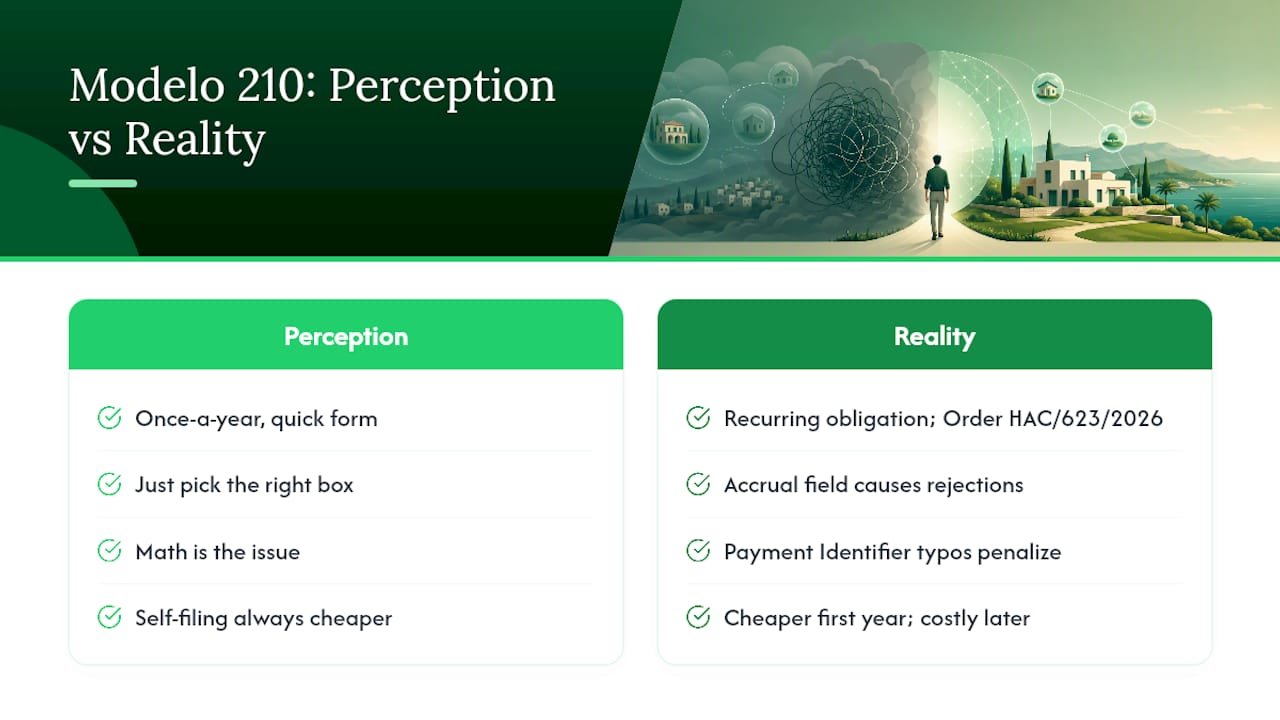
What I’d push back on is the idea that self-filing is always the cheaper option. It’s cheaper the first year, when everything goes smoothly. It gets expensive the year a mismatched IBAN turns into a surcharge, or a missed treaty claim leaves money sitting with the Tax Agency that you were owed back. The owners who come out ahead over five or ten years of ownership are usually the ones who either mastered the system properly, accrual periods, payment identifiers, cadastral revision dates, all of it, or handed the recurring work to someone who already had.
That’s not an argument for hiring help with every filing regardless of complexity. A single EU/EEA owner with one rental property and no sale on the horizon can genuinely manage this alone with the AEAT’s own tools. But the moment your situation involves a sale, a non-EU residency status, split personal and rental use, or a treaty refund claim, the cost of getting it wrong tends to outweigh the cost of getting it handled properly the first time.
— Jorge
This article is general information, not a substitute for advice from a qualified financial advisor. Consult a qualified financial professional about your own circumstances before acting on anything here.
Recommended
