
Over €50,000? Lawyer Reviewed Modelo 720 Filing in Spain by March 31

If you are a Spanish tax resident who held foreign assets above €50,000 in any of the model’s three categories as of December 31, you must file Modelo 720 online with the AEAT between January 1 and March 31. Miss a category threshold, mislabel an account, or skip the form entirely, and you risk penalties even after Spain’s post-2022 reforms softened the old regime. The rules are precise, but they are not complicated once you know which bucket your assets fall into.
TL;DR:
- Filing is mandatory if Spanish residents hold foreign assets exceeding €50,000 in any of the three categories, with each category threshold assessed separately.
- The valuation date for assets is December 31, and accurate currency conversion at that date’s exchange rate is crucial to avoid penalties.
- The form must be filed online between January 1 and March 31, using approved electronic identification methods; paper submissions are not accepted.
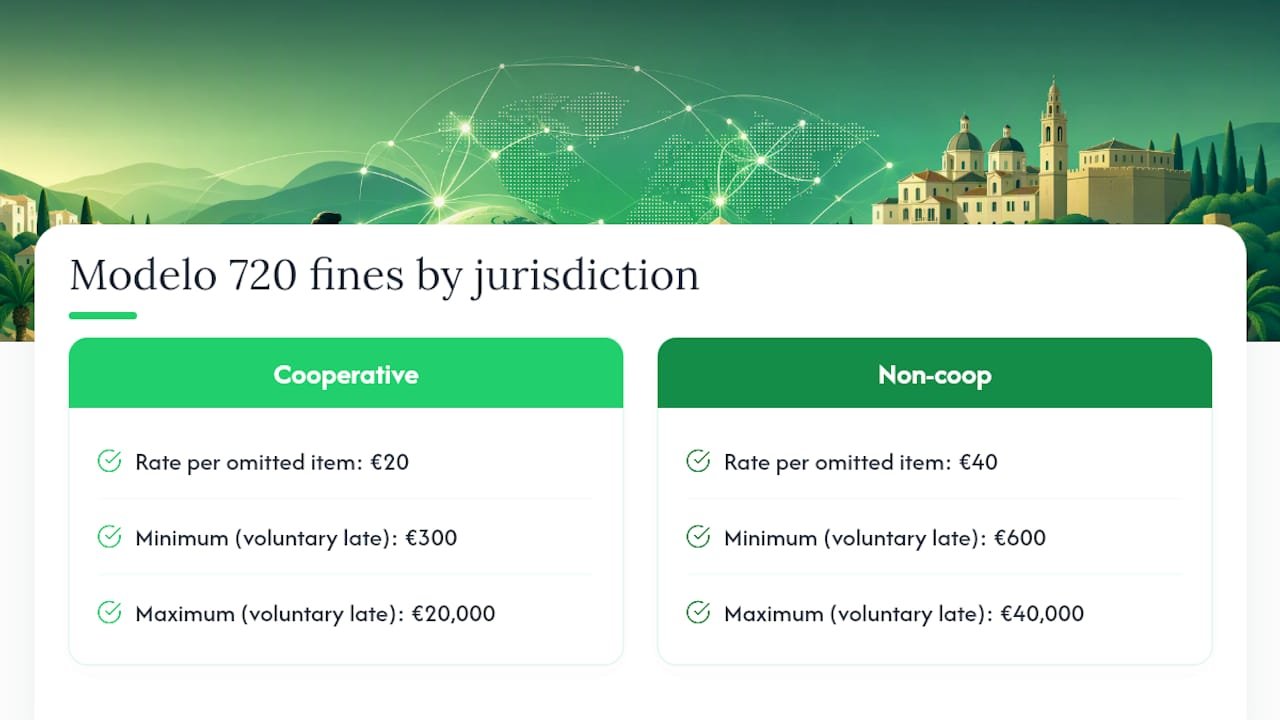
- Penalties are now limited to €20 per incorrect or omitted item, with a maximum of €20,000 for late filings, after reforms following a European Court of Justice ruling.
- Exemptions apply to Beckham Law beneficiaries and certain diplomatic individuals; consultation with a professional is advised for complex residency or timing issues.
Table of Contents
- What Is Modelo 720 and Why It Exists
- Who Must File Modelo 720 in Spain
- The Three Asset Categories, Thresholds, and Valuation Rules
- How to File Modelo 720 Online With the AEAT
- Deadlines and the December 31 Reference Date
- Modelo 720 Penalties After the CJEU Ruling
- Beckham Law and Other Exemptions From Modelo 720
- Common Modelo 720 Filing Mistakes and How to Fix Them
- Modelo 720 Filing Checklist Before You Start
- A Law Firm’s Perspective on When to Get Help
- How Law Cappital Handles Modelo 720 and Foreign Asset Reporting
- Sources
What Is Modelo 720 and Why It Exists
Modelo 720 is not a tax bill. It is an informative declaration, meaning you report the existence of foreign assets without paying tax on the act of declaring them. The AEAT’s own procedural page describes it as the official disclosure form for goods and rights held abroad, and it exists so Spain’s tax authority can cross-check what residents report on their income tax returns against what they actually hold outside the country.
The form was created by Orden HAP/72/2013, published in the Boletín Oficial del Estado (BOE), which set the original telematic filing procedure still in use today. That order has been amended since, but the core structure, three asset categories, a threshold per category, and mandatory electronic submission, has stayed intact for over a decade.
One detail trips people up: virtual currencies were not required on Modelo 720 for certain filing years, according to AEAT guidance. Crypto reporting now is handled through a separate form. Crypto reporting now runs through a separate form, Modelo 721, so do not assume your exchange balances belong on this declaration without checking the current year’s instructions first.
Who Must File Modelo 720 in Spain
Filing obligation hinges entirely on tax residency, not nationality or visa status. Spain uses several tests, and meeting any one of them makes you a tax resident for Modelo 720 purposes.
The most common trigger is the 183-day rule: spend more than half the calendar year physically in Spain, and you are a resident regardless of where your income originates. Absent that, Spain looks at your “center of economic interests,” meaning where the bulk of your income or business activity actually happens. There is also a family presumption: if your spouse and dependent children live in Spain, tax authorities can presume you are a resident too, even if you spend time abroad.
The obligation extends beyond individuals who directly own assets. Entities, beneficial owners of foreign structures, and people holding power of attorney over foreign accounts can all fall under the reporting requirement, according to AEAT’s FAQ on obliged taxpayers.
A handful of exceptions apply. Diplomats and consular staff posted abroad under specific IRPF Article 10 provisions may retain a different residency status that changes their filing duty. If your situation involves a mid-year move to or from Spain, check the AEAT FAQ directly. Partial-year residency scenarios are exactly where people miscalculate their obligation.
The Three Asset Categories, Thresholds, and Valuation Rules
Modelo 720 splits foreign holdings into three separate categories, and the €50,000 threshold applies independently to each one. Cross €50,000 in Category 1 but stay under it in the other two, and you still only report Category 1.

Category 1 covers bank and financial accounts abroad: checking accounts, savings accounts, and deposits held at foreign institutions. If you and a spouse jointly hold multiple accounts across two countries, add every balance together. Aggregation across all accounts in that category is what matters, not any single account.
Category 2 covers securities, rights, insurance, and income deposited or managed abroad: foreign brokerage holdings, shares, bonds, life insurance policies with a surrender value, and rights to pensions or annuities. Someone with a U.S. brokerage account and a foreign life insurance policy sums both against the same €50,000 line.
Category 3 covers real estate and rights over real estate located abroad: a vacation home, rental property, or even a right of usufruct over foreign real property. Recent practical guidance summarizing the current threshold and category structure confirms this three-way split has remained the framework since the form’s creation.
Valuation happens on December 31 of the reporting year. That date matters because currency swings and year-end account transfers can push you over or under the threshold depending on exactly when you check.
How to File Modelo 720 Online With the AEAT
Filing happens exclusively through the AEAT’s electronic system. There is no paper option and no mailed form.
You will need one of the accepted electronic identification methods: a personal digital certificate, the Cl@ve system, or DNIe (the electronic national ID for those who qualify). If a lawyer or accountant is filing on your behalf, they need documented authorization as your representative before AEAT will accept the submission.
Before you start, gather account statements as of December 31, property valuations or deeds for foreign real estate, and identifying numbers (account numbers, policy numbers, property registration details) for every asset above the threshold.
Practical steps for a clean submission:
- Confirm your representative’s power of attorney is registered with AEAT if someone else is filing for you
- Use the AEAT’s dedicated filing portal for the correct fiscal year, since each year has its own endpoint
- Check file format requirements before uploading, since AEAT technical pages note a limit around 40,000 records per submission for larger filers
- Save the secure verification code AEAT generates on successful submission. You will need it for any future correction
- Test your digital certificate or Cl@ve login in advance. Expired certificates are the single most common reason filings stall the week of the deadline
Deadlines and the December 31 Reference Date
Every figure on Modelo 720 reflects your asset values as of December 31 of the previous year. The filing window itself runs from January 1 to March 31 of the following year, giving you three months to gather statements and submit.
AEAT has occasionally granted short grace periods when its own systems experience technical failures close to the deadline, sometimes extending by a few additional days in exceptional circumstances. Do not count on this happening. Filing in the final week leaves no room if your certificate fails or a bank statement arrives late.
If this is your first year crossing the €50,000 threshold in any category, you file as a first-time declarant with no special transition procedure required. In subsequent years, you only need to refile if a category’s value increased by more than €20,000 over the previous declaration, or if you’re declaring for the first time in a category you hadn’t previously reported.
Modelo 720 Penalties After the CJEU Ruling
The penalty regime looks very different today than it did before 2022. Spain’s original fines for late or incorrect Modelo 720 filings were so severe, sometimes exceeding the value of the assets themselves, that the Court of Justice of the European Union ruled them disproportionate and incompatible with EU free movement principles.
Following that judgment, Spain restructured the sanctions through legislative reform. The current framework sets fines at €20 per data item omitted or incorrect, with a minimum of €300 and a maximum of €20,000 for voluntary late filings. That penalty doubles for assets held in jurisdictions Spain classifies as non-cooperative.
The CJEU ruling led Spain to establish a standard statute of limitations, limiting the retrospective assessment period for undeclared foreign assets.
If you discover a missed filing, the most cost-effective move is voluntary correction before any AEAT notice arrives. Document your reasoning for any late or amended filing, and keep every bank statement or valuation record that supports the numbers you submitted. If AEAT does send a notice, respond within the stated window. Ignoring it converts a manageable fine into a formal tax audit.
Beckham Law and Other Exemptions From Modelo 720
Beneficiaries of Spain’s special impatriate tax regime, commonly called the Beckham Law, are generally exempt from filing Modelo 720 because they are taxed as non-residents for most purposes even while living in Spain. That exemption is not automatic on the calendar, though.
If your Beckham Law application is still pending when the March 31 deadline arrives, you cannot assume the exemption applies retroactively. Plan the timing of your application with this in mind rather than discovering the gap after the deadline passes.
Assets you already hold through a Spanish bank or financial intermediary do not need separate Modelo 720 reporting. The intermediary already reports that data to AEAT directly, so double-reporting would be redundant. Crypto assets fall under Modelo 721 rather than 720, and certain income streams may intersect with other informative declarations depending on your specific holdings.
Common Modelo 720 Filing Mistakes and How to Fix Them
Most rejected or flagged Modelo 720 filings share the same handful of root causes.
- Currency conversion errors. Converting foreign balances at the wrong exchange rate, or at a date other than December 31, throws off the threshold calculation and can trigger a mismatch with bank records AEAT already has.
- Failing to aggregate accounts within a category. Reporting one savings account while forgetting a second one in the same category is one of the most frequent errors AEAT’s system flags.
- Missing the secure verification code from a prior filing. You need that code to submit a correction, and losing it turns a simple fix into a longer administrative process.
To correct an error, you file either a complementary declaration (adding information you previously omitted) or a substitute declaration (replacing an entire prior filing that was wrong). Both require referencing the original submission’s verification code, so keep that number somewhere permanent, not just in an email you might delete.
Ignore a known error rather than correcting it, and the timeline works against you.
Modelo 720 Filing Checklist Before You Start
Preparation determines whether your filing takes twenty minutes or three frustrating attempts.
- Pull account statements dated exactly December 31 for every foreign bank and brokerage account
- Gather property deeds and current valuations for any real estate abroad
- Request a year-end value letter from insurers for any foreign life insurance policy with cash value
- Confirm your digital certificate, Cl@ve credentials, or DNIe are active and not expired
- Build a single spreadsheet listing every asset, its category, and its December 31 value in euros before you open the AEAT portal
Pro Tip: Currency conversion timing causes more rejected filings than any other issue. Convert every foreign balance using the December 31 exchange rate consistently across every account, and keep a copy of the rate source you used in case AEAT ever asks.
If you hold rental property abroad, coordinate your Modelo 720 real estate entry with your separate obligations as a nonresident landlord; guidance on Modelo 210 filing for nonresident landlords covers that adjacent requirement in more depth.
A Law Firm’s Perspective on When to Get Help
Most Modelo 720 filings are straightforward once you understand the categories. Where clients run into trouble is residency ambiguity, mid-year moves, and Beckham Law timing that collides with the March 31 deadline. Jorge Lacasa Alesón leads Law Cappital, a Madrid firm focused on Spanish tax and immigration matters for foreigners, and the firm’s Beckham Law work regularly involves clients whose 24% flat rate on qualifying income up to €600,000 depends on getting the residency and filing sequence right the first time. A borderline residency case is not the place to guess.
— Jorge
How Law Cappital Handles Modelo 720 and Foreign Asset Reporting
There are alternatives to piecing together Modelo 720 compliance from AEAT FAQs and forum threads. When your residency status is genuinely ambiguous, when a Beckham Law application is running against the March deadline, or when you have already missed a filing year, generic guidance stops being enough.
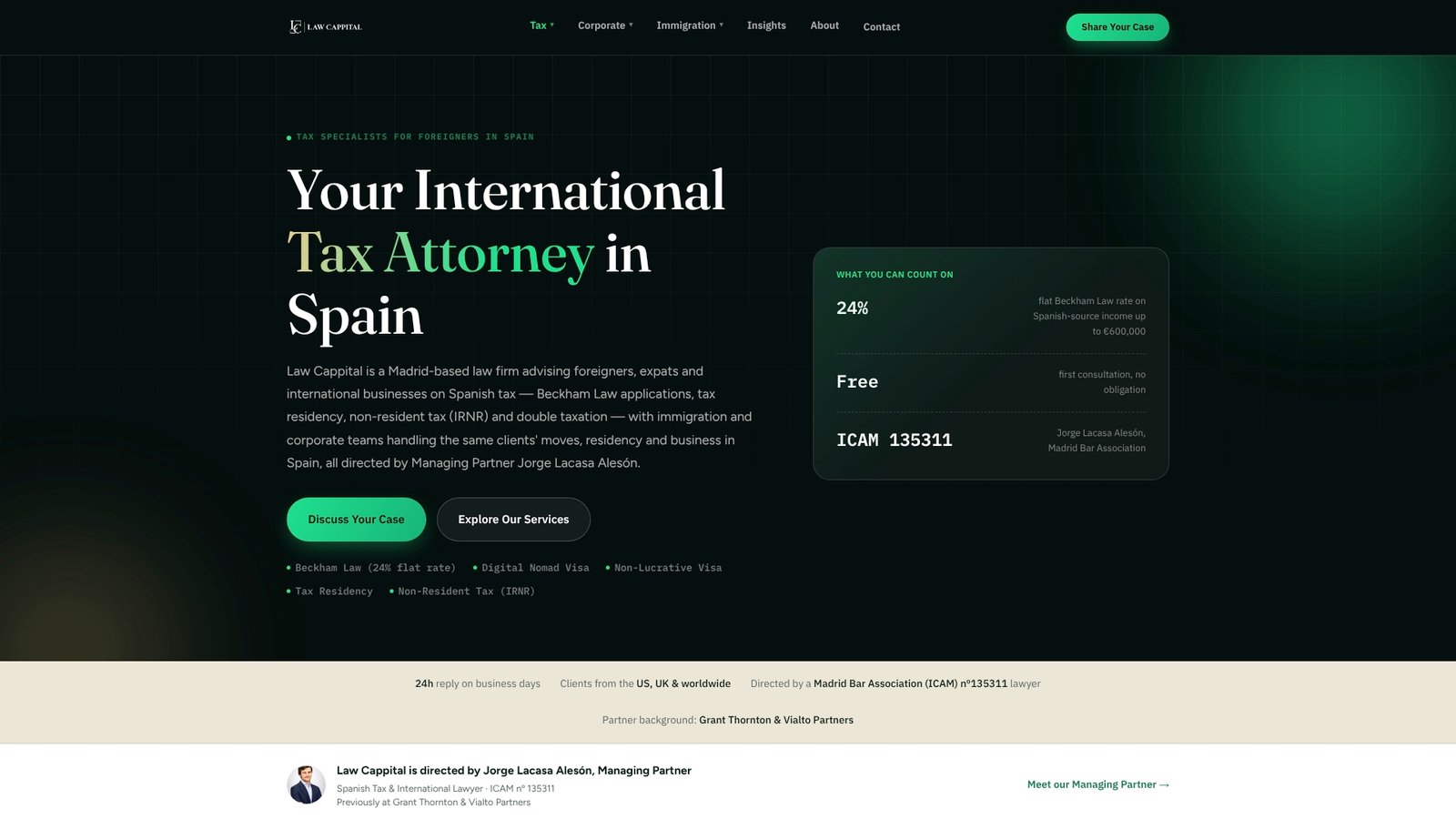
The firm’s Spanish tax services cover Modelo 720 preparation, representation before AEAT if a notice arrives, and negotiated corrections when a prior filing needs fixing. A first consultation can identify residency status, check which asset categories may apply, and flag any exemptions before filing. The outcome is a filed declaration you can stand behind, not a guess submitted under deadline pressure. Book a consultation through Law Cappital’s tax page to get your filing reviewed before March 31.
This article is general information, not a substitute for advice from a qualified financial advisor. Consult a qualified financial professional about your own circumstances before acting on anything here.
Sources
- Form 720. Informative Tax Return. Informative tax return on goods and rights held abroad.
- Modelo 720: Foreign Asset Declaration Guide (2026) | GuiaSpain
- AEAT online filing portal for Modelo 720 (E2025 index)
Recommended
