
Avoid Rejection: Spain’s 2026 EU Blue Card Salary Rule
The UGE-CE unit has a statutory resolution period of up to 20 working days to decide, and once granted, your card lets you move to other EU countries after 12 months in a way Spain’s national permits don’t allow.
TL;DR:
- Applicants must have a guaranteed fixed gross annual salary of at least 1.4 times the Spanish average wage to meet the salary threshold, excluding bonuses and equity.
- The application process involves filing online with UGE-CE, waiting up to 20 working days for a decision, and securing a visa if outside Spain, which adds extra processing time.
- The initial Blue Card is valid for up to three years and allows mobility within the EU after 12 months of holding the Spanish permit, with periods in other member states counting toward long-term residence.
- Common rejection reasons include shortfalls in fixed salary figures and insufficient documentation of experience, both of which can be mitigated by careful contract wording and thorough record preparation.
- Costs mainly involve government fees, translation, apostille, and potential legal support, especially for complex cases or when aligning the application with tax considerations like the Beckham Law.
Table of Contents
- What Are the EU Blue Card Spain Requirements and Salary Threshold?
- How Do You Apply for a Blue Card in Spain? Step by Step
- What Documents Do You Need for Your Blue Card Application?
- How Long Does the Blue Card Last, and Can You Move Within the EU?
- EU Blue Card or Spain’s National HQP Permit: Which Fits You?
- Blue Card Checklist: What Trips Up Most Applications
- What Does an EU Blue Card in Spain Cost?
- What Rights Come With Your Blue Card in Spain?
- Why Applications Get Rejected, and How to Appeal
- Where to Verify the Rules Yourself
- When Is It Worth Hiring Specialist Counsel?
- How Law Cappital Helps You Get the Blue Card Right the First Time
- Sources
What Are the EU Blue Card Spain Requirements and Salary Threshold?
Three things decide whether you clear the bar: your nationality, your contract, and your pay. You must be a non-EU national with a job offer or signed contract lasting at least six months, and you need either a university degree or five years of professional experience at a comparable skill level.
The salary threshold is where most applications live or die. Spain’s Orden PJC/44/2026 fixes the 2026 general threshold at a specific gross annual salary calculated as 1.4 times the national average wage published by the INE.
Only your guaranteed fixed salary counts. Bonuses, commissions, stock options, and performance pay do not go toward the threshold, no matter how reliably your employer pays them.
- Include: base salary, guaranteed allowances written into the contract, fixed housing stipends stated as salary
- Exclude: annual bonuses, sales commissions, discretionary awards, unvested equity
Worth flagging: some legal commentators, working from a later INE 2024 earnings release, calculate an alternative 2026 threshold of €41,356.36, with a reduced figure of €33,085.09. Confirm the figure UGE-CE is applying to your filing date before locking in a contract.
How Do You Apply for a Blue Card in Spain? Step by Step
- File the application electronically with the UGE-CE (Unidad de Grandes Empresas y Colectivos Estratégicos), the centralized unit that handles highly qualified worker cases across Spain.
- Wait for the statutory decision. UGE-CE has 20 working days to resolve the file. Positive administrative silence applies if that deadline passes without a response, though in practice you should still follow up.
- Get a national visa if you’re outside Spain. Once approved, applicants abroad must collect a category D visa from the nearest Spanish consulate, a step that typically adds several more weeks depending on the consulate’s backlog.
- Enter Spain and start work. You can generally begin working once your application file is complete and the visa or authorization is active, not only after the physical card arrives.
- Apply for your TIE within one month of entry to convert your approval into the physical foreigner identity card, and register your NIE if you haven’t already.
If UGE-CE denies the application, you have one month to file an administrative appeal (recurso de reposición) or go directly to contentious-administrative court.
What Documents Do You Need for Your Blue Card Application?
Your employment contract needs to state the guaranteed gross annual salary explicitly and in figures that match or exceed the applicable threshold. Vague wording about “competitive compensation” invites a request for clarification.
- Signed contract or binding job offer covering at least six months
- University degree, officially recognized or mapped to Spain’s MECES/EQF equivalence framework
- For the experience route: employment contracts, payslips, and reference letters spanning at least five years at a comparable skill level
- For the reduced threshold: proof of shortage-occupation status or degree issued within the last three years
- Apostilled and officially translated versions of any foreign-issued document
Pro Tip: If you’re claiming the reduced threshold through a shortage occupation, print the exact CNO-2011 code for your role along with the matching entry from SEPE’s shortage occupations catalogue, and write a short paragraph mapping your actual job duties to that code’s description. Caseworkers ask for this mapping more often than applicants expect.
How Long Does the Blue Card Last, and Can You Move Within the EU?
Your first card is valid for up to three years, renewable in two-year blocks as long as you keep meeting the requirements. Mobility is the feature that sets the Blue Card apart from national permits.
- Short-term business trips to other Schengen states follow standard 90/180-day rules
- After 12 months holding a Spanish Blue Card (or as little as 6 months in some transposition cases), you can move to take up a Blue Card job in another EU member state without starting the process from zero
- Time spent in Spain and, under Directive (EU) 2021/1883, certain periods in other member states count toward the five years needed for EU long-term resident status
- Extended absences from Spain can still reset or interrupt your residence clock, so track them carefully if you’re eyeing permanent residency
EU Blue Card or Spain’s National HQP Permit: Which Fits You?
Spain also runs a national Highly Qualified Professional permit under its own entrepreneurs and startups law, and the two routes overlap enough to confuse candidates.
- The Blue Card wins on mobility: it’s built for professionals who might relocate within the EU later
- HQP sometimes offers more flexible thresholds for specific corporate structures, but it stays valid only in Spain
- If your five-year plan includes another EU country, the Blue Card’s accumulation toward long-term residence makes it the stronger bet
- If you’re settling in Spain permanently with no EU-mobility ambitions, HQP’s administrative track can move just as fast
Blue Card Checklist: What Trips Up Most Applications
- Lock the salary figure into the contract in writing, stated as a guaranteed annual gross amount, before submission, not as a range or “up to” figure.
- Build your experience file early if you’re using the five-year route. Payslips alone rarely satisfy caseworkers. Pair them with signed reference letters describing actual responsibilities.
- Confirm shortage-occupation status against the current SEPE list, not last year’s, since the catalogue gets revised.
- Apostille everything foreign before you submit, since a missing apostille is one of the most common reasons files get bounced back for correction.
Pro Tip: Practitioners see more clarification requests over salary structure than any other single issue. If your compensation package includes bonuses or equity, restructure the contract so the base salary alone clears the threshold, then let the extras sit outside the calculation entirely.
What Does an EU Blue Card in Spain Cost?
Government fees for the Blue Card process are modest compared to what most applicants budget for legal support around them. Expect a visa application fee at the consulate stage if you’re applying from abroad, plus a separate fee for the TIE card itself once you’re in Spain, both set at the standard rates that apply to most residence authorizations rather than a Blue Card premium.
The real cost variable is professional support, not government fees. Document translation and apostille work adds up quickly, especially if you’re building a five-year experience file with contracts and letters from multiple employers in different countries. Degree equivalence mapping through MECES, when required, carries its own processing fee and timeline.
Legal representation for the full application, from initial eligibility review through TIE issuance, typically runs as a fixed project fee rather than an hourly one at firms that specialize in this work, since the process follows a predictable set of steps. Budget for the possibility of a request for additional documentation, which can add weeks and sometimes additional translation costs if your initial file was thin on evidence. Employers sponsoring the contract sometimes absorb part or all of these costs as a recruitment expense, particularly for roles that are hard to fill domestically, which is worth raising during salary negotiations rather than assuming you’ll cover it all yourself.
What Rights Come With Your Blue Card in Spain?
Family reunification is immediate, not delayed. Your spouse and dependent children can apply alongside you or shortly after, and unlike some national permits, they get their own work authorization without a separate labor-market test.
You’re enrolled in Spain’s social security system from your first day of registered employment, giving you access to public healthcare, unemployment protection if your contract ends, and pension contributions that count toward Spanish and, eventually, cross-border EU pension calculations. Working conditions, salary, dismissal protections, workplace safety, must match what Spanish nationals in equivalent roles receive; the Blue Card framework exists partly to prevent a two-tier labor market for skilled migrants.
One detail worth knowing early: Blue Card holders who haven’t been Spanish tax residents in the previous five years may qualify for the Beckham Law regime, a flat 24% tax rate on qualifying income up to €600,000, instead of Spain’s standard progressive scale. The election has to happen within a strict window after you start work, and immigration status alone doesn’t guarantee tax eligibility. The two tracks run on separate rules, so treat them as connected but distinct decisions.
Why Applications Get Rejected, and How to Appeal
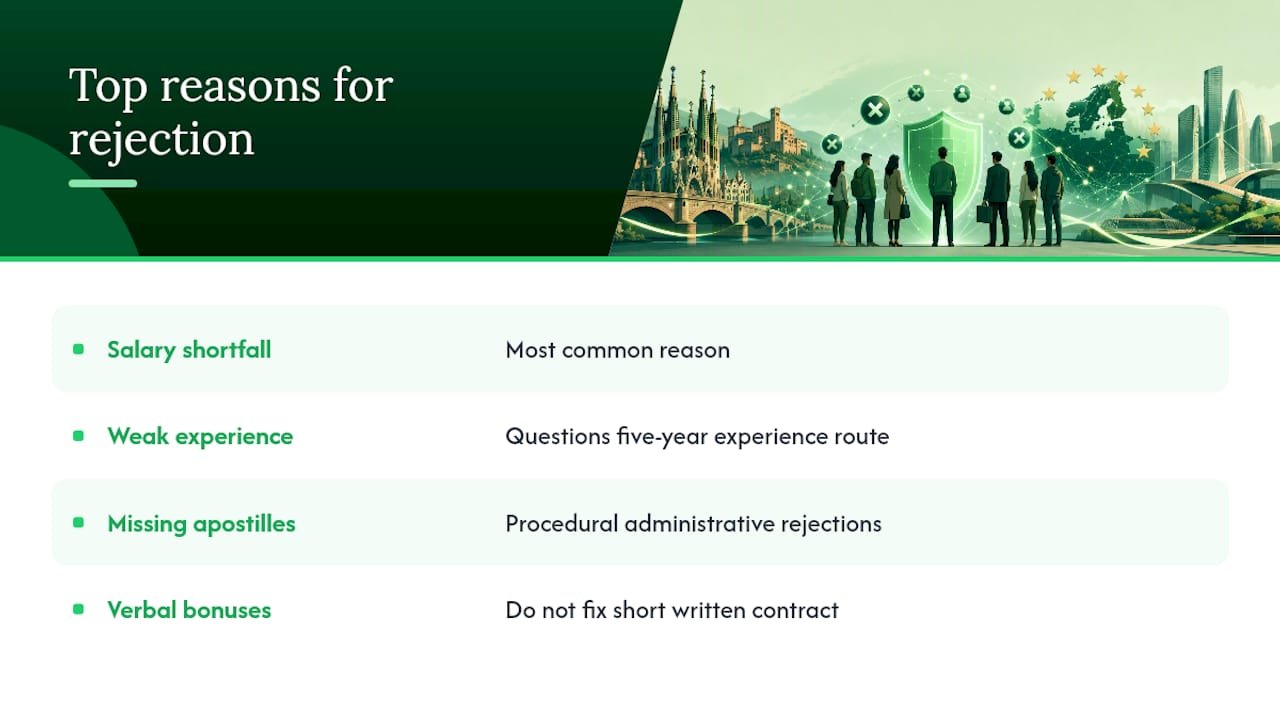
Salary shortfalls cause more denials than any other issue. If your contract’s guaranteed fixed component sits even slightly under the threshold, UGE-CE will reject or request clarification, and adding a verbal promise of a bonus after the fact won’t fix a written contract that falls short.
Weak experience documentation is the second most common problem. A stack of payslips without context, or reference letters that describe generic duties instead of the specific skill level required, gives caseworkers grounds to question whether the five-year experience route is genuinely satisfied. Missing apostilles or uncertified translations on foreign degrees and contracts cause procedural rejections that have nothing to do with your actual qualifications, they’re purely administrative, and entirely preventable.
If you receive a negative decision, you have one month to file a recurso de reposición, an administrative appeal asking UGE-CE to reconsider, or to escalate directly to contentious-administrative court. The reposición route is faster and doesn’t require a lawyer, though having one review the original denial letter often reveals whether the fix is a documentation gap you can close or a structural eligibility issue that needs a different visa strategy entirely. Reapplying with corrected paperwork is usually faster than waiting out a full appeal, provided the underlying eligibility, salary and contract terms, hasn’t changed.
Where to Verify the Rules Yourself
- BOE-A-2026-2142 for the official 2026 salary threshold text
- The EU Immigration Portal’s Spain page for procedural rules straight from the European Commission
- INE’s earnings survey to track the wage data that feeds next year’s threshold recalculation
Check UGE-CE’s own guidance for the shortage-occupation catalogue before assuming your role qualifies for the reduced threshold.
When Is It Worth Hiring Specialist Counsel?
Borderline salaries, thin experience-route evidence, or a regulated profession needing formal recognition are exactly where a second set of eyes catches problems before UGE-CE does. A short initial consult usually covers three things: whether your contract’s fixed salary actually clears the threshold, how strong your qualification evidence is, and whether Beckham Law timing intersects with your immigration filing.
— Jorge
How Law Cappital Helps You Get the Blue Card Right the First Time
Specialized legal services exist for moments when a Blue Card file gets complicated, salary structuring needs tightening, experience evidence needs organizing into something a caseworker will accept the first time, or a Beckham Law election must meet a strict deadline.
The firm handles application preparation end to end: reviewing your contract before submission, checking documents for the gaps that trigger clarification requests, and guiding you through TIE and NIE steps once you land in Spain. Because immigration and tax questions rarely stay separate, Lawcappital coordinates your Blue Card filing with a look at whether the Beckham Law makes sense for your income structure, so you’re not solving one problem while creating another. Every new client starts with a free consultation to map out the fastest, cleanest path for their specific contract and background. If you’re weighing a Blue Card offer right now, book a consultation with Lawcappital’s immigration team before you sign anything.
This article is general information, not a substitute for advice from a qualified lawyer. Consult a qualified legal professional about your own circumstances before acting on anything here.
Sources
- BOE-A-2026-2142 Orden PJC/44/2026
- Spain – European Commission – EU Immigration Portal
- EU Blue Card salary threshold 2026: how to hire a Highly Qualified Professional in Spain – Perez Parras Economistas y Abogados
Recommended
