
2026 Rental Income Tax in Spain: Claim Deductions After 2025 Ruling
Non-resident owners pay a tax on rental income: residents of the EU/EEA pay on net income, while other non-residents pay on gross income, filed on Modelo 210. Residents include rental income in their annual IRPF return under progressive rates. A July 2025 Audiencia Nacional ruling now allows non-EU owners to claim expense deductions too, though the tax office’s practice is still evolving.
TL;DR:
- Non-EU owners can now claim expense deductions on rental income following a 2025 court ruling, reducing their taxable amount.
- EU/EEA residents pay 19% tax on net rental income, while non-EU residents are generally taxed at 24% on gross income, though this may change.
- Rental income includes all tenant payments before deductions, with allowable expenses such as mortgage interest, IBI, repairs, and depreciation.
- Filing must be done annually between April 1 and 20 via Modelo 210, with separate rules and documentation for vacant periods and part-year rentals.
- Owners should review past filings in light of the new ruling, keep thorough documentation, and consider professional guidance to avoid penalties.
Table of Contents
- Who Pays Rental Income Tax Spain Rules Apply To?
- How Do You Calculate Taxable Rental Income?
- When and How Do You File Rental Income Tax in Spain?
- What Special Situations Change the Tax Treatment?
- What Mistakes Trigger Penalties?
- Where the Law Actually Stands in Practice
- Get Help Filing Rental Income Tax in Spain
- Sources
- FAQ
Who Pays Rental Income Tax Spain Rules Apply To?
Whether you file as a resident or a non-resident hinges on one test: did you spend 183 days or more in Spain during the calendar year? Cross that line and you’re a tax resident, reporting worldwide income, rental included, through IRPF. Stay under it, and you’re a non-resident dealing exclusively with income sourced in Spain, filed separately from any other tax obligations you have elsewhere.
Residents fold rental income into their annual IRPF return alongside salary, investments, and other earnings, taxed at progressive rates that climb with total income. There’s no separate rental tax form to worry about, just one line item in a bigger return.
Non-residents work through a different system entirely: the Impuesto sobre la Renta de No Residentes (IRNR), filed on Modelo 210. The rate split matters:
- EU/EEA residents pay 19 percent on net rental income, meaning deductible expenses come off the top first.
- Non-EU, non-EEA residents historically paid 24% on gross income, with no expense deductions allowed at all.
That second rule just got shakier. The Audiencia Nacional’s July 2025 ruling found that denying deductions to non-EU owners while granting them to EU owners breaches the principle of free movement of capital, a decision with real teeth for American, British, or Canadian landlords who’ve been overpaying for years.
How Do You Calculate Taxable Rental Income?
Rental income includes all amounts received from tenants, such as rent, utility charges, community fees, and furniture rental, before deductions.
From there, the Tax Agency’s own guidance lists what residents and EU/EEA non-residents can subtract:
- Mortgage interest (not the principal, just the interest portion)
- IBI, the annual local property tax
- Community fees for shared building costs
- Buildings insurance and, where applicable, contents cover
- Repairs and maintenance, though not improvements that add value
- Property management or letting agent fees
- Utilities the owner pays rather than the tenant
- Depreciation, calculated at 3% annually on the construction value, excluding the land itself
Pro Tip: Depreciation is the deduction most owners forget. You can claim 3% of the building’s value (never the land) every year you let the property, even in years with no major expenses.
If the property sits empty for part of the year, Spain still wants a number for that vacant period: imputed income, calculated as a small percentage of the cadastral value, depending on the valuation date. This applies whether you’re a resident with a second home or a non-resident who left the flat unrented over the winter. Skipping this return is one of the most common filing errors owners make, because it feels counterintuitive to declare income you never received.
Part-year rentals need two separate calculations: one for the months actually let, using full income minus deductions, and one for the vacant months, using the imputed income formula. Treat them as one blended figure and the numbers won’t match what the Tax Agency expects.
When and How Do You File Rental Income Tax in Spain?
Non-residents file Modelo 210, and since the regulatory update under Orden HAC/56/2024, rental income from the previous calendar year can now be grouped into one annual filing submitted between April 1 and April 20, rather than a separate return every quarter. Imputed income for vacant periods still follows its own calendar, due by December 31 of the year following the tax year.
Residents report everything through Modelo 100, the standard IRPF return, filed during Spain’s regular income tax campaign each spring.
- File electronically through the Agencia Tributaria portal using a digital certificate or Cl@ve PIN.
- Non-residents without Spanish digital credentials often need a fiscal representative to file on their behalf.
- Set up direct debit for payment early if you want to avoid a rushed bank transfer near the deadline.
- Keep your IBI receipt handy since it states the cadastral value you’ll need for imputed income calculations.
Pro Tip: File a few days before the April 20 deadline if you’re paying by direct debit. Domiciliación payments need lead time to process, and a last-minute submission can miss the payment window even if the return itself goes through on time.
What Special Situations Change the Tax Treatment?
Not every rental sits neatly inside the standard rules. A few situations shift the entire tax framework.
- Economic activity classification. Offer hotel-like services (daily cleaning, meal service, reception staff) or hire employees to run the property, and the Tax Agency may reclassify your rental as a business activity rather than passive income, potentially triggering corporate tax and VAT obligations.
- Short-term tourist lets. Regions including the Balearic Islands and Catalonia require local registration numbers displayed on every listing. Booking platforms now report host activity directly to tax authorities, which raises audit exposure for anyone letting without proper registration.
- Part-year letting. As covered above, this requires filing both a rental income return and a separate imputed income return for vacant months, not one combined figure.
- Double taxation treaties. Spain holds the primary right to tax rental income from Spanish property regardless of where the owner lives. Your home country’s treaty with Spain typically provides a credit for tax already paid here, but the mechanics vary by treaty, so check the specific text rather than assuming a standard formula applies.
Jointly owned properties split the tax burden according to ownership percentage. Each co-owner, resident or not, typically files their own Modelo 210 or IRPF declaration for their share of the income, which means a property owned 50/50 by a UK resident and a Spanish resident generates two completely different tax filings on the same rental.
What Mistakes Trigger Penalties?
The Tax Agency doesn’t need to audit aggressively to catch the errors that show up most often: skipped imputed income returns, cadastral values pulled from memory instead of the IBI bill, and deduction claims that assumed the old non-EU rules still applied without checking the 2025 ruling’s actual scope.
- Late filing brings a fixed penalty plus interest on any unpaid tax, calculated from the original deadline.
- Underreporting income or overclaiming deductions can escalate to a formal assessment with its own penalty structure layered on top.
- Non-EU owners currently claiming deductions under the new case law should keep full documentation and consider a protective claim if the tax office pushes back, since administrative practice hasn’t fully absorbed the ruling yet.
Pro Tip: If you catch your own mistake before the Tax Agency does, file a corrective return immediately. Voluntary corrections typically carry lower penalties than ones discovered through an audit.
Where the Law Actually Stands in Practice
It isn’t anymore, not after the Audiencia Nacional’s July 2025 decision. Treating it as fixed costs costs owners real money every filing season.
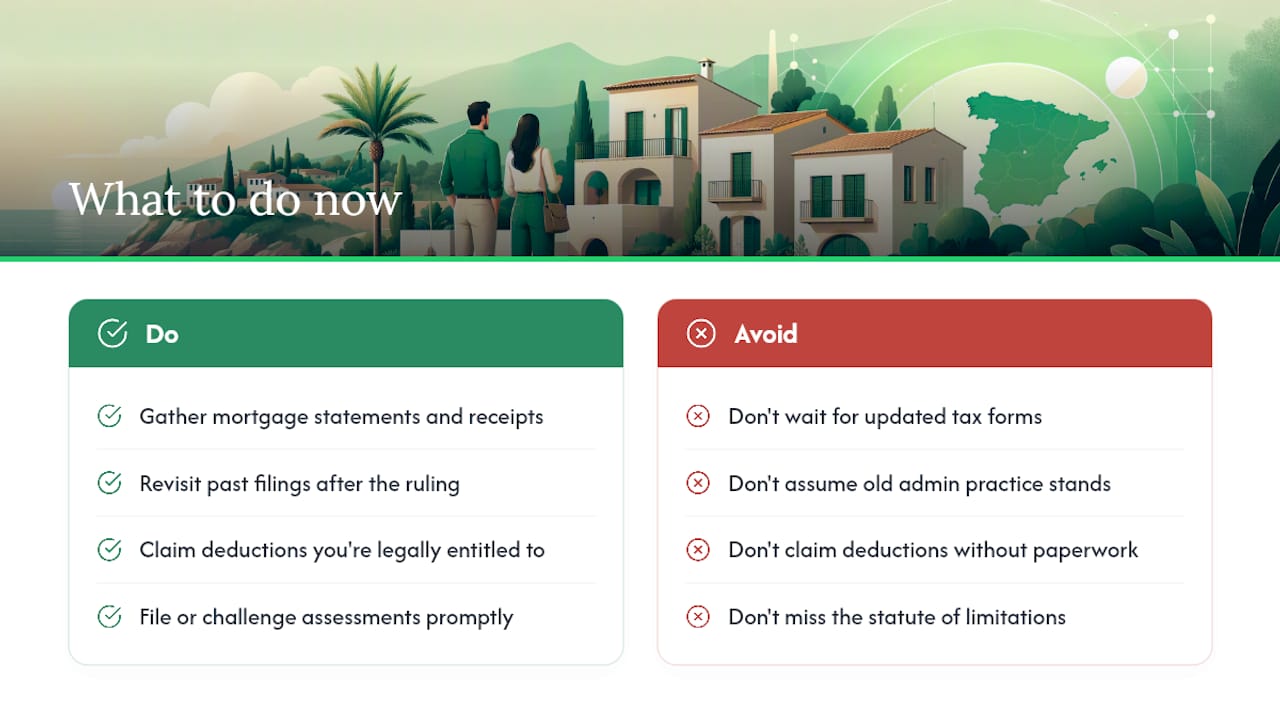
The bigger issue is timing — as seen by comparing Spain’s approach with property taxes in Italy for non residents. Court rulings move faster than administrative practice, and the Tax Agency’s own systems and staff often keep applying the old rules until formal guidance catches up. That gap is where owners lose out, either by not claiming deductions they’re now entitled to, or by claiming them incorrectly without the paperwork to back a challenge if questioned.
My view: don’t wait for the tax office to update its forms before you act. If you’re a non-EU owner who’s been paying 24% on gross income for years, that ruling gives you grounds to revisit past filings, not just future ones. The conventional advice, “wait and see how the rules settle”, ignores that statutes of limitations run whether you act or not. Prioritize getting your documentation in order now, mortgage statements, invoices, repair receipts, so you’re ready to file correctly or challenge a past assessment before the window closes.
— Jorge
Get Help Filing Rental Income Tax in Spain
Getting the numbers right on Modelo 210 or your IRPF return is one thing. Knowing whether the 2025 court ruling actually applies to your specific filing history, and how to document a claim the tax office will accept, is another. Legal firms specialize in assisting foreign property owners navigating Spanish tax obligations, addressing complex cross-border tax issues like those discussed.

The firm’s Spanish tax services cover rental income filings, non-resident deduction claims under the new case law, and coordinated advice when your rental income tax question overlaps with residency status or corporate structuring. If you’re a US owner juggling treaty credits on top of Spanish filings, the US to Spain tax guide addresses that overlap directly. Many firms offer initial consultations to help clients determine applicable tax forms, potential deduction claims, and necessary documentation. Book that consultation before your next filing deadline rather than after a penalty notice arrives.
This article is general information, not a substitute for advice from a qualified financial advisor. Consult a qualified financial professional about your own circumstances before acting on anything here.
Sources
FAQ
What Are the New Rental Rules in Spain Starting in 2026?
The biggest shift isn’t a new law but the practical fallout from the July 2025 Audiencia Nacional ruling, which opens the door for non-EU owners to claim rental expense deductions previously reserved for EU/EEA residents. Combined with the annual filing grouping introduced under Orden HAC/56/2024, owners now file rental income once a year between April 1 and 20 instead of quarterly.
Are Taxes Higher in Spain or the USA?
It depends entirely on income level and type. Spain’s progressive IRPF rates for residents can run higher than comparable US federal brackets at similar income, but non-resident rental income taxed at 19 percent (EU/EEA) is often lower than what the same income would face under US state and federal combined rates.
How Much Tax Do You Pay in Spain on €70,000 Income?
Non-residents don’t use this scale at all.
Is It Wise to Buy Property in Spain Right Now?
That depends on your goals more than the tax rules themselves, but the 2025 ruling on non-EU deductions makes rental ownership meaningfully more attractive for American, British, and other non-EU buyers than it was before, since the tax drag on rental income just got lighter for that group. Anyone weighing a purchase should factor in both the rental tax treatment and broader questions like residency and, if relevant, Beckham Law eligibility before committing.
Recommended
