
€3.86: 3 Ways Expats Get Spain’s Criminal Record Certificate
Spain’s Ministry of Justice issues the Certificado de Antecedentes Penales through its Registro Central de Penados, and it shows only final criminal convictions, nothing pending or dismissed. You can request it three ways: online with a digital ID, in person or by mail through a territorial office, or via a consulate or authorized representative if you’re outside Spain. Foreign use usually requires an apostille or legalization on top of the base certificate.
TL;DR:
- Requests by digital ID are fastest and often provide immediate results if no criminal record exists, but delays can occur with complex international checks.
- Applying in person usually yields the certificate within one to three business days, while mail and consular options take longer and require additional certification steps.
- The certificate only shows final convictions recorded in Spain’s criminal registry; arrests or pending cases are not listed.
- For foreign use, an apostille or legalization is necessary, and processing time can extend up to 30 days for EU nationals if ECRIS records are involved.
- Legal help with notarized powers of attorney and apostilles can significantly reduce delays, especially for urgent or cross-border applications.
Table of Contents
- What You Need Before You Apply
- How Do You Apply for the Criminal Certificate Online?
- Applying In Person, By Mail, or Through a Consulate
- Can Someone Else Request the Certificate for You?
- What Does It Cost and How Long Does It Take?
- What Information Actually Appears on the Certificate?
- Common Mistakes That Slow Down Your Application
- Why Legal Representation Sometimes Beats Doing It Alone
- Let Law Cappital Handle the Paperwork You Can’t
- Sources
- FAQ
What You Need Before You Apply
Most applicants need this certificate for a visa, residency renewal, a public-sector job, or a private employer’s background screening. If the role involves working with minors, you’ll need a different document entirely: the Certificado de Delitos de Naturaleza Sexual, which the general criminal record certificate does not replace.
Before you start, gather the basics:
- A valid ID: DNI, TIE, or passport, depending on your status
- Form 790-006, the official payment form for the request
- Proof of payment (bank receipt or online transaction confirmation)
- Certified copies of your ID if you’re applying from outside Spain
Pro Tip: Immigration authorities and employers often want a certificate issued within the last three months. If your deadline is more than a few weeks out, wait to request it, otherwise you may end up applying twice.
How Do You Apply for the Criminal Certificate Online?
The fastest route runs through the Ministry’s electronic headquarters, and it works well if you already hold Spanish digital credentials. You’ll need one of three authentication methods: a digital certificate installed on your browser, an electronic DNI with a card reader, or Cl@ve, the government’s mobile-verified identity system. Cl@ve is usually the easiest for residents to set up since it only requires a brief in-person registration at a police station or tax office.
Once you’re authenticated, the process runs like this:
- Log into sede.mjusticia.gob.es and select “Certificado de Antecedentes Penales.”
- Choose the apostille option at this stage if you plan to use the certificate abroad.
- Pay through the integrated Form 790-006 gateway using a card.
- Download the resulting PDF, which carries a CSV verification code that anyone can check against the Ministry’s database.
When you have no criminal record, the system often issues the PDF instantly. If it doesn’t generate right away, you can track the request through your assigned number or the Mi Carpeta portal.
Pro Tip: Save the CSV code somewhere separate from the PDF itself. Some consulates and employers ask for it independently to verify authenticity without opening the document.
Applying In Person, By Mail, or Through a Consulate
If you don’t have digital credentials, or you’re not in Spain, three other paths exist, each with real limitations worth knowing before you commit to one.
- In person: Book an appointment at a Gerencia Territorial, bring your original ID and a paid Form 790-006, and you’ll often walk away with the certificate the same day, or within one to three business days.
- By mail from Spain or abroad: Send legalized or certified (“compulsada”) copies of your ID along with payment proof, roughly €3.86 via Form 790-006, to the Oficina Central de Atención al Ciudadano or the relevant territorial office. Include an email or postal address so they can send you the download link or notification once it’s ready.
- Through a consulate: Staff can certify your ID copies and walk you through the correct payment method, but they do not issue the certificate themselves, and they only serve applicants within their consular jurisdiction.
Mail applications from abroad generally take longer than in-person or online requests, so build in extra buffer time.
Can Someone Else Request the Certificate for You?
Only you or a properly authorized representative can request your criminal record certificate. If you’re stuck abroad without Spanish digital ID and can’t visit in person, a notarized power of attorney lets a lawyer or trusted person act on your behalf. That POA typically needs an apostille before Spanish authorities will accept it, since it originates in another country’s notarial system.
Your representative should carry the signed authorization, a copy of your ID, proof of payment, and an explicit written statement naming them as your agent for this specific request. Missing any one of these documents is the most common reason representative requests get bounced back.
What Does It Cost and How Long Does It Take?
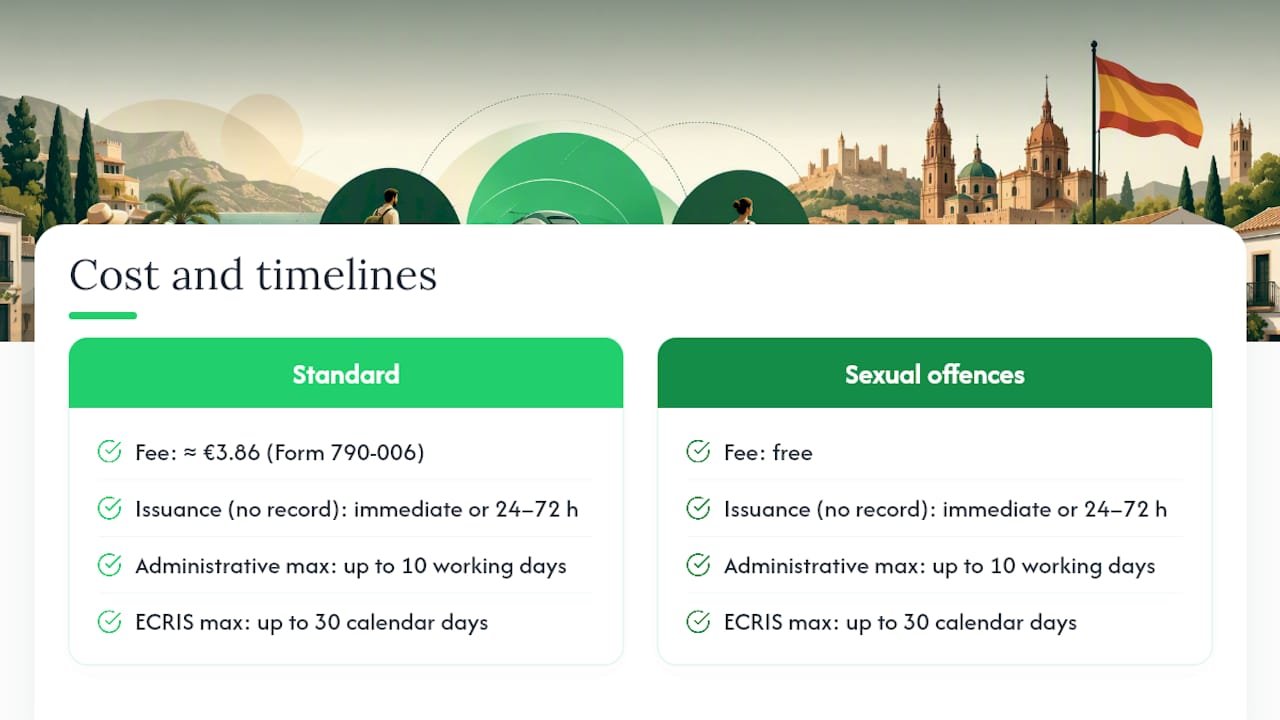
The standard fee is approximately €3.86, paid through Form 790-006. The sexual-offences certificate, by contrast, costs nothing.
Timing varies by method and by your record itself. When you have no criminal history, issuance is often immediate online or within 24 to 72 hours through other channels. The Ministry’s own administrative maximum is 10 working days, but that window stretches to as long as 30 calendar days when ECRIS checks apply, mainly for EU nationals whose home country has to supply conviction records to the Spanish registry.
Delays usually trace back to one of a handful of causes: uncertified ID copies, submitting the wrong type of background check (some countries require a federal check rather than a state or regional one), skipping the apostille step, or applying for the general certificate when the situation actually calls for the sexual-offences version.
What Information Actually Appears on the Certificate?
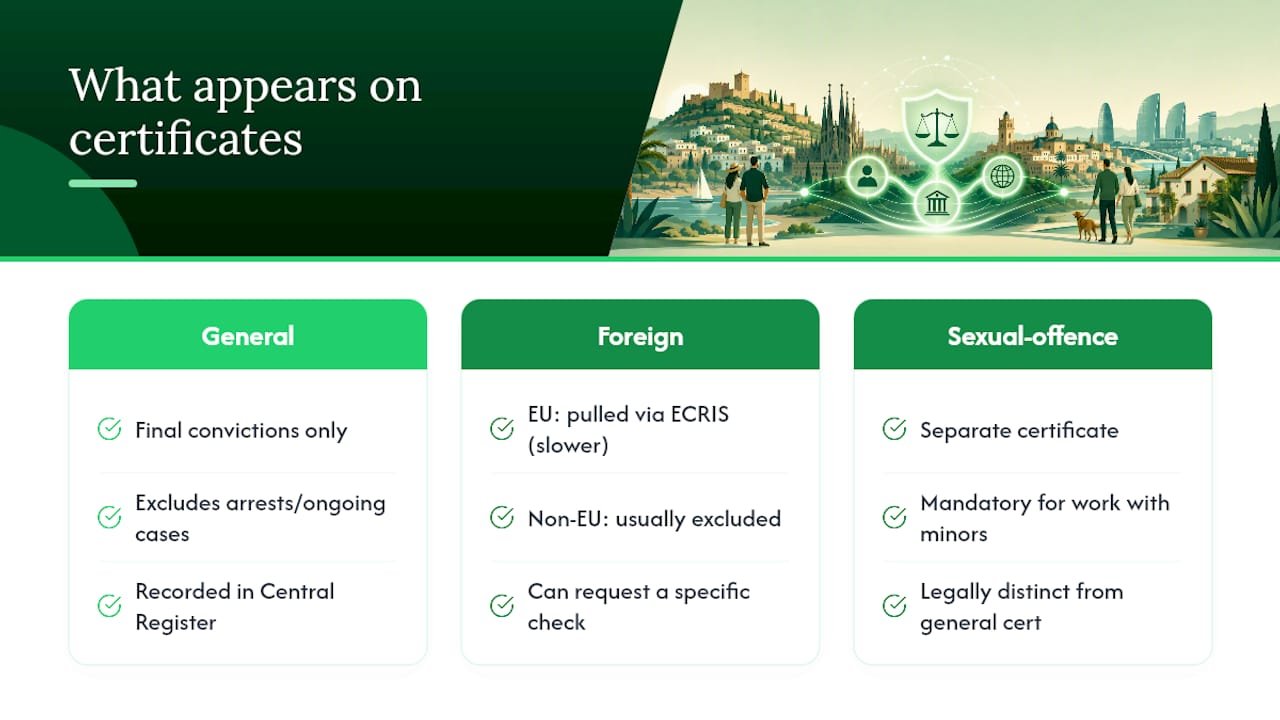
The certificate lists only final convictions, sentencias firmes, recorded in the Registro Central de Penados. Arrests that never led to conviction and cases still working through the courts don’t show up at all.
If you’re an EU national, the Ministry can pull your conviction history from your home country through ECRIS, the European Criminal Records Information System, which is exactly why those requests take longer. Outside the EU, foreign convictions typically stay off the certificate unless you specifically request that check.
The sexual-offences certificate operates on a separate track entirely. It’s mandatory for anyone working with minors, whether in education, coaching, healthcare, or volunteer roles, and Spanish law treats it as legally distinct from the general criminal record certificate rather than an optional add on.
Common Mistakes That Slow Down Your Application
A surprising number of rejections come down to sequencing rather than eligibility. Apostille or legalize a document first, then get it translated. Doing it backward means the sworn translator is certifying a document that isn’t yet legally recognized abroad, and authorities will send it back.
Other frequent errors:
- Submitting a state-level or regional police check when the destination country requires a federal one
- Letting the certificate expire before submission, since many authorities won’t accept one older than three months
- Requesting the general certificate for a role that legally requires the sexual-offences version instead
Pro Tip: If you’re overseas without Spanish digital credentials, notarize and apostille a power of attorney for a lawyer in Spain early. That single document unlocks the online, in-person, and consular routes all at once.
Start the whole process at least six to eight weeks before any hard deadline. Apostille processing and international mail add time you can’t always predict.
Why Legal Representation Sometimes Beats Doing It Alone
Managing a notarized power of attorney, an apostille request, and a sworn translation across two countries takes more coordination than most applicants expect, especially against a visa clock. Jorge Lacasa Alesón, Managing Partner at Law Cappital, has guided expat clients through exactly this kind of cross-border paperwork. Legal help earns its cost most clearly when deadlines are tight, when your record spans multiple countries, or when you have no digital ID and no way to appear in Spain yourself.
— Jorge
Let Law Cappital Handle the Paperwork You Can’t
There are services available that arrange notarized powers of attorney, request and track apostilles, coordinate sworn translations, and handle the back-and-forth with consulates to help prevent document delays impacting visa deadlines.
If you’re preparing a residency renewal, a permanent residency application, or a visa that depends on a clean criminal record certificate arriving on time, our immigration services team can take the document chase off your plate entirely. For the sworn translation step specifically, firms like Solvendi Abogados walk through what that process looks like once your apostille is in hand. Reach out to legal professionals for a consultation to determine which route, online, mail, or representative, best fits your timeline.
This article is general information, not a substitute for advice from a qualified lawyer. Consult a qualified legal professional about your own circumstances before acting on anything here.
Sources
FAQ
How Long Is the Criminal Record Certificate Valid?
Spain doesn’t set a fixed legal expiration, but most visa offices, employers, and immigration authorities only accept one issued within the past three months.
What’s the Difference Between the General Certificate and the Sexual-Offences Certificate?
The general certificate covers all final convictions and costs about €3.86, while the sexual-offences certificate is a separate, free document required for anyone working with minors.
Can I Apply for the Certificate If I No Longer Live in Spain?
Yes. You can apply online with a digital certificate or Cl@ve, by mail with certified ID copies, or through a consulate that certifies your documents and forwards instructions, or you can authorize a representative in Spain with a notarized, apostilled power of attorney.
Does the Certificate Show Arrests or Pending Cases?
No. It lists only final convictions recorded in the Registro Central de Penados; arrests and ongoing cases without a conviction don’t appear.
How Long Does Processing Take If I Have No Criminal Record?
It’s often immediate online, or issued within 24 to 72 hours through other channels, though the Ministry’s administrative maximum runs up to 10 working days, and up to 30 days when ECRIS checks apply for EU nationals.
Recommended
