
Sign a Spanish Power of Attorney Same Day, Include a Preventive Clause
A notarized power of attorney lets a trusted person sign, pay, and sell on your behalf in Spain, and it’s the standard fix when you can’t be there in person for a property closing, a tax filing, or a court date. Most expats sign it before a Spanish notary or a consulate abroad, then get it apostilled for use outside Spain. Do it while you have full legal capacity, and specify up front whether you also want a preventive clause for future incapacity.
TL;DR:
- Most expats need a specific power of attorney for property sales, banking, or court representation, with clear scope and property details to avoid rejection.
- A preventive power of attorney must be signed while healthy to remain valid after loss of mental capacity, making early planning crucial.
- The notarized document requires an apostille or consular legalization depending on the destination country, and proper registration is essential to revoke or update it.
- Drafting involves precise wording, choosing the correct type, and verifying identity and capacity during a notary or consulate appointment to prevent delays.
- Working with professional firms can streamline the process, including drafting, notarization, apostille, and delivery, especially for cross-border or complex cases.
Table of Contents
- What Types of Power of Attorney Exist in Spain?
- When Do Expats Actually Need a Power of Attorney?
- How Do You Get a Valid Power of Attorney in Spain?
- Preventive Powers: Planning for a Time You Can’t Sign Anything
- How Do You Revoke a Power of Attorney, and How Long Does It Last?
- Apostille or Consular Legalization: Which Do You Need?
- What to Check Before You Sign
- Law Cappital’s Experience Handling POAs for Foreign Clients
- Who Is Legally Allowed to Grant a Power of Attorney in Spain?
- Power of Attorney vs. Mandate: What’s the Legal Difference?
- What Formalities and Language Requirements Apply?
- What Risks Should You Watch For Before Granting Power?
- What Does the Attorney-in-Fact Actually Have to Do?
- How Does a Power of Attorney Interact With Inheritance and Family Matters?
- The Part Most Guides Get Wrong
- Need Help Drafting or Filing a Power of Attorney?
- Sources
- FAQ
What Types of Power of Attorney Exist in Spain?
Spanish law recognizes four main categories, and picking the wrong one is the single most common reason a POA gets rejected at a notary’s office or a bank counter later.
A general power of attorney (poder general) covers broad estate and property management: paying bills, managing rental income, filing routine paperwork, running day-to-day affairs when you’re not physically present. It’s the widest grant you can give, which is exactly why some notaries and banks scrutinize it more closely before accepting it.
A special or specific power (poder especial) is narrower and usually safer for a one-off transaction, like authorizing someone to sign the deed for a single named property, close one bank account, or complete one specific sale. Notaries typically ask for the property’s cadastral reference or account number written directly into the document, which limits what your attorney-in-fact can actually do.
A litigation power (poder para pleitos) is required for representation in Spanish courts or before certain administrative bodies. This type often works alongside a procurador, a court-facing legal representative distinct from your lawyer, and litigation guidance confirms courts commonly demand this exact grant before accepting anyone acting on your behalf in a proceeding.
A preventive power (poder preventivo) is built specifically for future incapacity: it stays valid even if you later lose the mental capacity to manage your own affairs, which an ordinary POA does not survive.
- General: broad, ongoing management of assets and affairs
- Special: one transaction, one named asset, tightly worded
- Litigation: court and administrative representation, often paired with a procurador
- Preventive: designed to remain effective after loss of capacity
Notary guidance on POA types breaks these categories down further, including how each interacts with property sales, banking, and inheritance matters.
When Do Expats Actually Need a Power of Attorney?
Property is the biggest driver. If you’re selling a Spanish home from abroad, a special power authorizing the sale of that specific property, cadastral reference included, lets someone sign the deed in front of the notary while you stay in another country entirely.
Banking and tax administration come next. A POA lets an appointed person manage your Spanish accounts, submit tax filings on your behalf, or chase down a refund from the Agencia Tributaria without you flying back every time paperwork lands.
Rental management is another common case: signing leases, setting up utility contracts, or instructing a local property manager all require someone with documented authority to act, not just a friend with a spare key.
- Selling or buying property while living outside Spain
- Managing bank accounts, tax filings, and refund claims
- Handling leases, utilities, and local property management
- Court or administrative representation through a litigation power
Litigation and administrative procedures round out the list. Anything from a tax dispute to a residency appeal may require formal representation, and without the right power on file, your lawyer’s hands are effectively tied.
How Do You Get a Valid Power of Attorney in Spain?
The process is straightforward once you know the sequence, but skipping a step, especially around apostilles, is what causes delays back in Spain.
1. Decide the exact type and scope. Write down precisely what your attorney-in-fact can and cannot do. A special power naming one property by cadastral reference avoids the ambiguity that gets general powers questioned at the registry.
2. Choose your signing route. You can sign before a notary inside Spain, at a Spanish consulate in your home country, or, increasingly, through secure remote video procedures introduced under recent notary rules. The notary’s role in every case is to verify your identity, confirm your mental capacity, and rule out any sign of duress.
3. Gather your documents. Required paperwork typically includes a valid passport and, for non-residents, a Spanish Foreigner Identity Number (NIE). Bring identifying details for your attorney-in-fact, any relevant property or account references, and originals rather than photocopies wherever possible.
4. Notarize, apostille, and deliver. Once signed, the document needs a Hague apostille for international recognition, or consular legalization if the destination country isn’t a Hague Convention member. Certified copies then get sent to Spain for use at the registry, bank, or court.
Fees follow fairly predictable bands depending on document type and length, though exact figures vary by notary and how many certified copies you need.
| Step | What happens | Typical timing |
|---|---|---|
| Drafting the powers | Lawyer or notary drafts exact scope and limits | 1 to 3 days |
| Signing | Notary, consulate, or remote video appointment | Same day |
| Apostille or legalization | Applied to the notarized document | A few days to a couple of weeks |
| Delivery to Spain | Certified copies sent to registry, bank, or lawyer | Varies by courier and destination |
Published notary fee guidance notes that costs scale with the complexity of the powers granted and the number of copies requested, so a simple special power for one property typically costs less than a broad general power covering multiple assets.
Preventive Powers: Planning for a Time You Can’t Sign Anything
A preventive power (poder preventivo) is the one document most expats skip until it’s too late. It must be granted while you have full mental capacity, because that’s precisely what makes it valid later if you lose that capacity.
Ordinary powers of attorney generally lapse the moment the grantor becomes incapacitated. That’s a real exposure point for expats with property, bank accounts, or a business in Spain and no local family nearby: without a preventive clause on file, nobody can act for you if illness or an accident takes away your ability to manage your own affairs.
Drafting one means including specific survivability language that keeps the grant alive through incapacity, and the notary verifies your capacity at the moment of signing, not after. It’s worth setting up alongside a will or property purchase, not as an afterthought once health concerns already exist.

How Do You Revoke a Power of Attorney, and How Long Does It Last?
Revoking a POA requires a formal deed of revocation signed before a notary, and you also need to notify banks and the attorney-in-fact directly that their authority has ended.
If the original power was registered anywhere, such as the Land Registry or the Companies Register, consular guidance makes clear you need to notify that registry separately. Skipping this step means third parties can keep relying on the old power even after you’ve revoked it privately.
Most POAs end one of four ways: a fixed expiration date written into the document, formal revocation, the principal’s death, or a specific legal trigger named in the deed itself. Preventive powers are the exception; they’re designed to keep working through incapacity rather than end at that point.
Apostille or Consular Legalization: Which Do You Need?
A Spanish notarial POA travels internationally through one of two routes. If the destination country is part of the Hague Apostille Convention, a single apostille stamp on the notarized document is enough for foreign banks, registries, or courts to accept it.
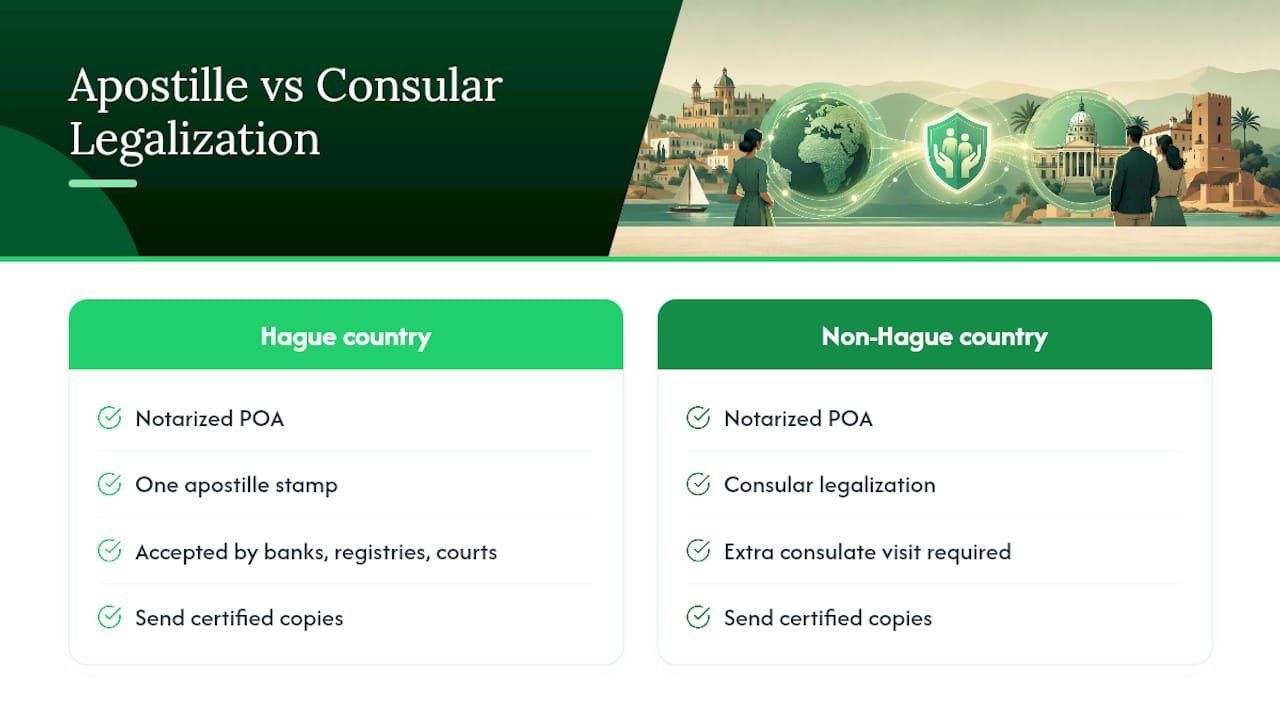
If the country isn’t a Hague member, consular legalization takes over instead, which usually means an extra visit to the relevant consulate. Either way, send certified copies rather than the sole original when dealing with foreign registries, and confirm in advance exactly what format the receiving institution expects.
What to Check Before You Sign
A rushed signing is where most POA problems start. Before you put your name on anything, walk through this checklist with your notary or lawyer.
- Confirm your passport and NIE are current and match exactly what’s on the draft document.
- Read the exact wording granted, not a summary of it, especially around property sale authority.
- Ask whether the power includes a preventive clause, or whether it lapses on incapacity.
- Decide how many certified copies you need and who holds the original.
- Confirm whether an apostille or consular legalization applies to your destination country.
Ask directly: does this survive my incapacity? Is the sale of this specific property explicitly authorized, or only implied? How and where do I file a revocation if I change my mind?
Pro Tip: Watch for vague property descriptions in the draft. A power that says “my property in Spain” instead of naming the exact cadastral reference is a common reason registries kick documents back for correction.
Law Cappital’s Experience Handling POAs for Foreign Clients
Managing Partner Jorge Lacasa Alesón built Law Cappital around one recurring problem: foreigners in Spain need tax, immigration, and property matters handled together, not in separate silos. That coordination matters most with POAs, where drafting, notary scheduling, apostille processing, and registry filing all have to line up correctly for a property sale or court case to go through cleanly. Clients get a free initial consultation to identify exactly which type of power fits their situation, backed by bilingual support that keeps things moving whether you’re signing from Madrid or from abroad.
Who Is Legally Allowed to Grant a Power of Attorney in Spain?
You need full mental capacity at the moment of signing, no exceptions. The notary’s job during the appointment includes actively assessing that capacity, not just checking a box.
Age matters too: you generally need to be a legal adult to grant most powers, though limited exceptions exist for specific acts under Spanish civil law. If there’s any doubt about capacity, whether due to illness, medication, or cognitive decline, the notary can refuse to proceed, and that refusal is a safeguard, not an obstacle.
For non-residents, having a valid passport and an NIE on hand speeds up the appointment considerably. Without an NIE, some notaries will still proceed for certain document types, but expect delays if your attorney-in-fact needs to register the power against a property or bank account later, since most Spanish institutions expect that number on file.
One point that catches expats off guard: capacity is assessed at signing, not retroactively. If a family member later challenges a POA on capacity grounds, the notary’s contemporaneous assessment carries real weight, which is another reason preventive powers get drafted early rather than waiting for a health scare to force the issue.
Power of Attorney vs. Mandate: What’s the Legal Difference?
Spanish law distinguishes between the poder (power of attorney) and the contrato de mandato (mandate contract), and confusing the two causes real problems.
A power of attorney is a unilateral act: you grant authority to someone else, and that authority is what third parties, banks, notaries, courts, rely on to accept your attorney-in-fact’s signature. It’s fundamentally about proving representation to the outside world.
A mandate is a bilateral contract between you and the person acting for you, governing the internal relationship: what they’re obligated to do, what they get paid, how disputes between the two of you get resolved. In practice, most POAs in Spain are granted alongside an underlying mandate, even an informal one, but the POA itself is what a bank or registry actually inspects. If your attorney-in-fact exceeds what the mandate contract permits but stays within what the POA authorizes, third parties who relied on the POA in good faith are typically still protected, while your recourse against the attorney-in-fact becomes a separate, internal dispute.
What Formalities and Language Requirements Apply?
Every power of attorney intended for use in Spain, or for a Spanish institution to rely on, must go through a Spanish notary or a Spanish consulate to carry full legal weight. A private, unnotarized document signed abroad generally won’t be accepted by a Spanish bank, registry, or court.
Language matters as much as the notarial step. If you sign abroad in English or another language, Spanish institutions will typically require an official Spanish translation attached to the document before they’ll act on it. Some consulates handle bilingual drafting directly, which avoids a separate translation step later; that’s worth asking about when you book the appointment, since it can save a week or more of back and forth once the document reaches Spain.
What Risks Should You Watch For Before Granting Power?
The biggest risk with any POA is scope creep: granting broader authority than the situation actually requires. A general power handed to a relative “just in case” can be used for far more than you intended, since the document itself, not your private understanding, is what a bank or buyer relies on.
Financial abuse is the scenario every family worries about, and it’s the reason notaries actively verify capacity and absence of duress rather than simply witnessing a signature. Choosing a narrower special power over a general one, whenever the task allows it, is the single most effective safeguard against misuse.
Keep control over the original document and know exactly how many certified copies exist and who holds them. If a power was ever registered against a property or company, remember that revoking it privately isn’t enough. You need to notify that registry directly, or the old authority can keep being relied on by someone who has no idea it’s been revoked.
What Does the Attorney-in-Fact Actually Have to Do?
An attorney-in-fact (apoderado) is bound to act strictly within the powers granted, and Spanish law expects that authority to be exercised in the principal’s interest, not the attorney’s own.
That means sticking to the document’s exact wording. If a special power authorizes selling one named property at a minimum price, the attorney-in-fact can’t use it to sign an unrelated contract or negotiate below that floor without separate authorization. Exceeding the granted scope can expose the attorney-in-fact to personal liability toward the principal, even if a third party who relied on the document in good faith remains protected.
Attorneys-in-fact are also expected to keep records: what was signed, when, and on whose instruction, particularly for ongoing general powers covering bank accounts or rental income. That documentation is what protects the attorney-in-fact if their actions are ever questioned later, and it’s also what a principal should ask to see periodically rather than waiting for something to go wrong.
How Does a Power of Attorney Interact With Inheritance and Family Matters?
A power of attorney ends automatically at the principal’s death, full stop. From that moment, the attorney-in-fact has no authority to act, and any attempt to do so has no legal effect. This trips up families who assume a POA lets someone “settle the estate” after a death; it doesn’t, and probate or inheritance proceedings require an entirely separate legal process.
During the principal’s lifetime, a broad general power can touch family law indirectly. Someone managing your Spanish assets under a general power might handle matters connected to a divorce settlement, a family business, or property jointly owned with a spouse, but the power itself needs to explicitly cover those acts. Vague general wording rarely satisfies a notary or registry when the transaction involves shared marital property or a pending inheritance dispute.
Preventive powers deserve special attention here, since incapacity planning and estate planning often go hand in hand. Drafting a preventive POA at the same time as a will, rather than years apart, keeps both documents consistent about who’s authorized to act and under what circumstances, which matters enormously if a dispute among heirs ever surfaces.
The Part Most Guides Get Wrong
Most advice on this topic treats a power of attorney as paperwork you sort out when a specific need arises, a sale, a filing deadline, a court date. That reactive approach is exactly backwards for expats. The single biggest risk isn’t picking the wrong type of power. It’s not having any preventive clause in place before you actually need one, at which point it’s legally too late to fix.
The conventional wisdom also underplays how much the notary’s judgment matters. Remote signing and consular routes have made the process more accessible, but the notary’s verification of capacity and absence of duress hasn’t gotten any lighter. If anything, that scrutiny is the safeguard that protects you from a family member or a hastily chosen attorney-in-fact overreaching later.
My honest recommendation: draft the narrowest power the task actually requires, put a preventive clause in place while you’re healthy, and treat the apostille step as part of the process from day one, not an afterthought once the document is already sitting in a drawer.
— Jorge
Need Help Drafting or Filing a Power of Attorney?
Getting a POA right in Spain means coordinating three things at once: precise drafting, the correct notary or consular appointment, and the apostille or registry filing that makes it usable once it lands. There are firms that handle that whole sequence for property sales, litigation representation, and cross-border filings, so you’re not juggling a notary, a translator, and a courier separately.
If your POA need centers on a property transaction, from a special power to sign a sale deed to registry follow-up after closing, Law Cappital’s real estate lawyers handle the whole chain from drafting through delivery to Spain. For POAs tied to residency or visa paperwork, the firm’s immigration services team covers that side directly. Either way, it’s advisable to start with an initial consultation to identify which type of power actually fits your situation before you sign anything.
This article is general information, not a substitute for advice from a qualified lawyer. Consult a qualified legal professional about your own circumstances before acting on anything here.
Sources
- Powers of attorney
- Online Notarial Preventive Power — Notaría Online
- Power of attorney in Spain (Poder notarial) – Guide | Age in Spain
FAQ
How Long Does a Power of Attorney Last in Spain?
It lasts until a fixed end date written into the document, formal revocation before a notary, or the principal’s death, whichever happens first. Preventive powers are the exception, since they’re built to remain valid through incapacity rather than end at that point.
Can a Power of Attorney From Spain Be Used Internationally?
Yes, with the right authentication. A Hague apostille makes a Spanish notarial POA recognizable in any Hague Convention member country, while consular legalization is required for countries outside that convention.
What Form Does a Power of Attorney Take in Spain?
There’s no single fill-in-the-blank form. A notary or lawyer drafts the exact wording based on the type you need, general, special, litigation, or preventive, and it’s signed before a notary or at a consulate to become legally valid.
What’s the Easiest Way to Get a Power of Attorney in Spain?
For most expats, the simplest route is a special power drafted for one clear purpose, signed at a Spanish consulate abroad or through secure remote video notarization, then apostilled if needed. Working with a firm to coordinate drafting, notarization, and apostille filing can remove most of the back and forth that otherwise stretches the process out.
Recommended
